

Functional & Holistic Medicine
Functional Medicine Doctor in San Antonio, TX: What to Verify Before Booking
Start with the care model you are trying to verify
Functional medicine focuses on identifying and addressing the root cause of disease. It looks at multiple possible causes of symptoms rather than focusing only on one diagnosis and treatment. That gives you a useful starting point, but it does not tell you whether a particular practice has a sound evaluation process.
Functional medicine examines how digestion, hormones, metabolism, immune function, stress, and lifestyle interact as connected systems. When you contact a provider, ask how that broad view will be turned into a practical assessment of your symptoms, history, goals, and current care. A label alone is not a care plan.
A Cleveland Clinic study found that patients seen by its Center for Functional Medicine had significantly larger improvements in PROMIS global physical health at 6 months than patients seen in primary care. At 12 months, the functional-medicine patients showed improvement similar to that observed at 6 months, but the improvement was not significant compared with the improvement in primary-care patients. Use that finding as context, not as a promise about your outcome or a reason to skip ordinary medical care.
Your first filter is simple: can the provider explain who will evaluate you, what information the evaluation will gather, why each test is being considered, how recommendations will be made, and how follow-up will work? If the answers are vague, keep comparing. If the answers are specific, you have something concrete to assess against your needs, schedule, existing clinicians, and budget.
Verify the clinician behind the label
The clinician’s license and training matter more than the phrase functional medicine doctor. Functional medicine may be practiced by different licensed professionals, and functional medicine is not a board-certified specialty. Check the underlying license, qualifications, relevant training, and clinical judgment instead of treating the label as a credential.
A physician’s credentials and state license are direct questions to ask before you book. If you are specifically looking for a medical doctor, check that the clinician has MD or DO credentials and is licensed to practice medicine in the relevant state. Ask who will make medical decisions, what falls within that person’s scope, and which concerns require another clinician.
Postgraduate functional-medicine training is another useful verification point. Ask whether the clinician has completed recognized training, such as the Institute for Functional Medicine certification program, and ask what the training involved. Verify the details directly rather than relying on a logo, a directory entry, or an unexplained abbreviation.
Cleveland Clinic became the first academic medical center to open a Center for Functional Medicine in 2014. That historical detail does not establish that every practice follows the same model. Your decision should rest on the qualifications and care pathway of the clinician you are considering.
Use a short credential question set before discussing tests or treatment:
- What professional license does the clinician hold, and in which state is it active?
- Who will conduct the evaluation and make medical decisions?
- What functional-medicine training has that clinician completed?
- What concerns are outside the practice’s scope?
- How will the practice involve your primary-care clinician or a specialist when needed?
Clear answers help you distinguish a licensed clinical relationship from a marketing label.
Ask what the evaluation and testing are meant to establish
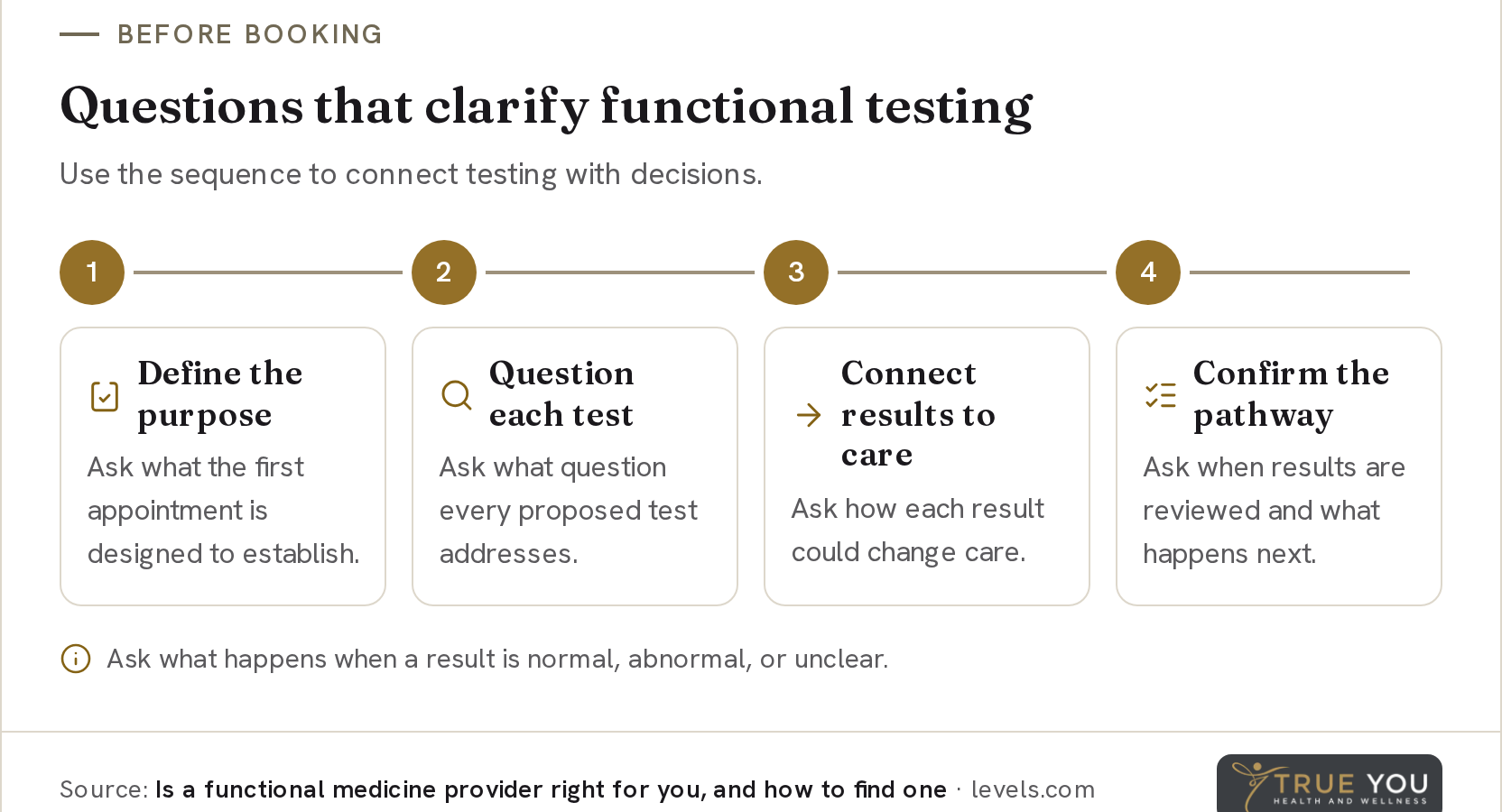
A functional-medicine initial assessment often lasts 60 to 90 minutes and may cover your full health history, diet, sleep, stress, and environment. A broader evaluation may also include vital signs, biomarkers, lifestyle questions, a physical exam, and additional evaluations. Ask what the first appointment is designed to establish, who will conduct each part, and what happens if the initial history points toward routine primary care or specialist evaluation.
A functional-medicine provider may discuss health markers beyond standard tests, including vitamin D3 levels, glucose intolerance, or C-reactive protein. The existence of an additional test does not explain its value for you. Ask three questions about every proposed test: What question does it address? How could the result change care? What will happen if the result is normal, abnormal, or unclear?
Laboratory testing should come with a clear explanation of what is ordered and why. Before booking, ask which panels are included in the program cost, which tests cost extra, whether an outside laboratory will bill you separately, and whether at-home testing kits are available. Ask for the answer in writing when possible so you can compare the complete pathway rather than a consultation price alone.
Your symptoms and prior results should shape the questions, not force you into a diagnosis. For fatigue, brain fog, poor sleep, low mood, or weight that will not change, ask how the practice separates symptom description from a medical conclusion. A provider who can explain the sequence from history to examination, testing, interpretation, and next decision gives you a more useful basis for comparison than a provider who begins with a predetermined test panel.
The testing conversation should end with a decision path, not merely a list of options. Ask when the provider will review results, which findings would lead to routine follow-up, and which findings would prompt referral or another form of care. You can then compare practices on the reasoning behind testing, the expected charges, and the next decision after each result.

Trace how findings become a coordinated care plan
A treatment recommendation should have a reason you can understand. Ask how dietary changes, lifestyle modifications, supplements, and prescription medications fit into the plan, and ask why each recommendation is being made. Also ask what would cause the plan to change and how progress will be reviewed; a longer list of interventions does not by itself show that the plan fits your needs.
Functional medicine is often used alongside conventional care, so ask how the provider will coordinate with your primary-care clinician and specialists. Share your full treatment plan with every clinician involved so they can consider possible supplement - medication interactions. Coordination should include a practical way to exchange records, recommendations, and changes to your plan.
A provider may tailor a program to your test results, and the program may be long-term. Ask when results will be reviewed, how often follow-up occurs, what support is available between visits, and which decisions require another appointment. Root-cause care takes time, so you need to understand the review points before you agree to a pathway.
The Cleveland Clinic passage describes an improvement of 5 points or more in PROMIS global physical health scores as clinically meaningful and noticeable in daily life. That description applies to the measure and study context, not automatically to your symptoms or goals. Ask any provider which outcome will be tracked, how it will be measured, and what result would prompt a different course.
Use this short coordination checklist during an inquiry:
- Who reviews your results and makes treatment decisions?
- How are your primary-care clinician and specialists kept informed?
- Which supplements or medications require special discussion?
- When is the first follow-up, and what support is available between visits?
- How will the provider respond if the proposed approach does not address your concern?
A coordinated plan should also make its boundaries clear. Ask whether the provider expects you to continue existing care, how medication changes would be handled, and who should answer questions between appointments. Do not stop a prescribed medication or start a supplement plan based only on an online article or an initial conversation.
Price the entire San Antonio care pathway before committing
Functional-medicine office visits are usually not covered by most insurers, although some laboratory testing or eligible medications may be covered. Coverage may also be limited or denied for hormone, gut-health, or inflammation laboratories outside standard insurance networks. Ask your insurer and the practice about each component separately instead of treating the word insurance as a complete answer.
Insurance codes do not usually cover the time or complexity of functional medicine care. A 60-minute root-cause consultation does not fit the 10-15-minute billing model most insurers reimburse. That is a billing limitation, not a quote for any San Antonio practice. Ask what you would pay directly and whether separate laboratory or medication charges apply.
Your total cost question should cover the full sequence, not only the first conversation. Ask for the consultation charge, follow-up charge, laboratory charges, outside laboratory billing, supplements or medications that may be recommended, cancellation terms, and the expected number of visits before the first plan review. Ask whether a superbill is available and what reimbursement attempt would involve, while treating reimbursement as uncertain until your plan gives you a current answer.
Visit format is part of price and fit. Ask whether the practice offers in-person care in San Antonio, telehealth for your location, or another arrangement; ask where laboratory work would occur; and ask which appointments must be in person. A lower apparent cost may not fit your schedule if travel, separate testing, or repeated visits are required.
Record the answers in separate lines for the first visit, follow-up visits, laboratory work, medications or supplements, and travel or telehealth requirements. Then ask which charges are known before booking and which depend on later findings. This gives you a usable comparison without turning an estimate into a promise.

Prepare evidence and questions for the first conversation
Your preparation package should include the intake questionnaire, a complete medication and supplement list with doses, prior laboratory work and records ideally 2 to 3 years back, a symptom timeline, and your top goals. At Parsley, intake questionnaires take about 30 minutes and cover symptom history, medical background, lifestyle, and goals; that example shows why the intake may require more detail than a short appointment form.
Past records can show trends that a single result cannot, so gather laboratory work and relevant medical records ideally 2 to 3 years back. Write a symptom timeline that names when each symptom started, what was happening around that time, and what makes it better or worse. Include changes in sleep, stress, diet, activity, illness, or medication only as observations you can describe accurately.
Your medication and supplement list should include every prescription, over-the-counter product, vitamin, herbal product, and dose. Supplements can interact with prescriptions, and some, including biotin, can distort laboratory results. Bring the labels or photographs of the labels if that is easier. Use the list to ask informed questions, not to diagnose yourself or change prescribed treatment.
A first functional-medicine visit is usually 60 minutes or more, while the typical first conventional visit in the comparison is about 18 minutes on average. The difference does not prove that one format is right for you. Use it to ask what the extra time covers, whether results are reviewed in a separate visit, and what preparation the practice expects before you arrive.
Bring questions that connect your experience to the provider’s process:
- Which of my concerns should the first evaluation address?
- Which records should I send before the appointment?
- What will you decide during the first visit, and what waits for test results?
- How will my existing medications and clinicians be included?
- What should I expect to pay before the next review?
These questions keep the conversation focused on fit and next decisions rather than on choosing a cause in advance.
Preparation is useful when it describes your experience accurately. Bring questions about symptoms, goals, prior evaluations, medications, supplements, and records, but leave diagnosis and treatment decisions to a qualified professional. Do not stop prescribed treatment to make an appointment or laboratory result easier to interpret.
Use True You Health and Wellness as a separately verified option
We are based in Fredericksburg, Virginia, so we are not a San Antonio office. Our practice is cash-based and out of network, so we do not bill insurance. If you are considering us from San Antonio, ask whether the Fredericksburg location or an available visit format fits your needs before treating us as an option.
Dr. Hoff is board-certified in Emergency Medicine and has 20 years of practice. Those credentials describe his background; you still need to ask whether our scope and process fit the concerns you want to discuss.
Our first visit includes blood work the same day if possible, followed by a virtual visit to review results and agree on a plan. We make treatment decisions after receiving lab results, typically at a second visit that can be completed by video. Ask how that sequence would work for your location, what laboratory arrangements apply, and which parts of the process require you to be in Fredericksburg.
Many of our follow-up appointments can be completed by video. We also intentionally limit the number of patients we see so we can focus on their goals. Ask how that follow-up format, availability, and communication process would apply to your situation rather than assuming that a video appointment removes every location or laboratory requirement.
Care pathways can differ in staffing and timing. At Cleveland Clinic’s Center for Functional Medicine, new patients see a registered dietitian and health coach in addition to a provider, and the initial visit typically lasts about 60 to 75 minutes. A typical first conventional visit is about 18 minutes on average, while a first functional-medicine visit is usually 60 minutes or more. Compare what each practice actually includes rather than using appointment length as a stand-alone quality signal.
If you contact us, ask these practical questions:
- Is the Fredericksburg location workable for my needs, and which visits can occur by video?
- What is included in the first visit and same-day blood work when possible?
- When are laboratory results reviewed, and when are treatment decisions made?
- What are the cash charges for the first visit, follow-up, and any additional testing?
- How will my existing clinicians and current treatment plan be considered?
Use the answers to compare us with other providers on the same criteria, without assuming that our process fits every situation.
Our Fredericksburg location and available visit formats are separate questions from whether our clinical approach fits your goals. Confirm the practical arrangement, laboratory steps, payment expectations, and follow-up format before you decide whether to make an inquiry.
Put urgent symptoms ahead of provider comparison
Persistent, unexplained fatigue may be a reason to discuss a root-cause evaluation with a qualified professional, but chest pain or shortness of breath is not a situation for a routine root-cause work-up. If you have chest pain or shortness of breath, do not wait for a provider comparison or routine consultation; seek immediate qualified medical help instead.
Urgent or potentially dangerous symptoms change the order of decisions. Do not use a symptom checklist, online explanation, supplement plan, or scheduled functional-medicine inquiry as a substitute for prompt medical attention. If you are unsure whether symptoms are urgent, contact a qualified professional or the responsible emergency authority promptly.
Bring the verified questions to one next conversation
Start by recording the clinician’s location, available visit format, laboratory arrangements, results review, treatment decisions, and record-sharing process for this San Antonio search. Record where the clinician is based, whether the available format serves your location, where laboratory work occurs, how results are reviewed, when treatment decisions are made, and how relevant records can be shared with existing clinicians. Exclude any pathway whose practical arrangements do not fit before weighing its clinical scope, testing rationale, follow-up, and payment expectations against your goals and schedule. This keeps a Fredericksburg option distinct from a San Antonio local office and prevents a video visit from obscuring laboratory or care-coordination requirements. A qualified professional must decide whether any particular evaluation or treatment is suitable for you.
If you are considering us, keep the Fredericksburg location, available video visits, cash-based model, laboratory sequence, and follow-up process in view as you make that comparison. The right next question is not whether a practice uses the functional-medicine label; it is whether you understand what will happen, who will make decisions, how care will connect with your existing clinicians, and what the full pathway will require.
Before you commit, make sure you can answer these questions:
- Who will evaluate you, and what license and training do they hold?
- What will the first visit cover, and why is each test being considered?
- What will you pay for the consultation, follow-up, laboratory work, and other additions?
- Which visits are in person or by video, and where will testing occur?
- How will your existing clinicians, medications, and future results be coordinated?
If the care format, clinical process, logistics, and payment expectations fit, a consultation can be a focused next conversation rather than a commitment to treatment.
Next step
Want a doctor who looks for the root cause?
Dr. Brian Hoff sees patients at our boutique, cash-based practice in downtown Fredericksburg, VA, with time to listen and a plan built around you.
More on Functional & Holistic Medicine
See functional medicine Functional & Holistic Medicine
Is Functional Medicine Evidence-Based? How to Evaluate the Research and Care
Learn how to assess functional medicine research, tests, treatments, risks, and care with a qualified clinician.
Read article Functional & Holistic Medicine
Women’s Functional Medicine Near Me in Fredericksburg, VA: How to Verify Care Before You Inquire
Compare women's functional medicine near me in Fredericksburg, VA by provider, testing, safety, follow-up, costs, and access.
Read article Functional & Holistic Medicine
Functional Medicine Lutz: How to Verify Fredericksburg Care Before Booking
Assess functional medicine care from Lutz, verify Fredericksburg access, prepare questions, and understand potential costs.
Read article