

Functional & Holistic Medicine
Women’s Functional Medicine Near Me in Fredericksburg, VA: How to Verify Care Before You Inquire

Begin with the question your inquiry must answer
Women in Fredericksburg who are dealing with fatigue, brain fog, low mood, poor sleep, weight concerns, or other persistent symptoms need an inquiry that answers more than “Do you offer functional medicine?” The useful question is whether the practice can explain who provides care, how it approaches an unresolved concern, why it recommends a particular evaluation, what follow-up looks like, and what you will pay. That screen helps you compare a nearby option without assuming that a hormone, thyroid, metabolic, digestive, or other cause explains your symptoms.
Functional medicine looks for underlying root causes of symptoms rather than treating symptoms in isolation. A functional medicine consultation may be helpful when symptoms are persistent, recurring, or difficult to explain in a short appointment. That description is a possible fit, not a diagnosis and not a promise that this approach will identify the cause of your symptoms.
Common concerns associated with functional medicine consultations include chronic fatigue, bloating, constipation, headaches, trouble sleeping, mood changes, weight fluctuations, hormone-related symptoms, and general inflammation. You do not need to arrive with a label for your symptoms. You need enough detail for a qualified clinician to understand what has been happening, what has already been evaluated, and what you want clarified.
Before you contact a practice in Fredericksburg, write down the decision you are trying to make. For example:
- Do I need a more detailed review of a persistent concern?
- Can the clinician explain what information would change the next step?
- Will the practice coordinate with my existing clinicians when another type of care is appropriate?
- Can I understand the full cost and follow-up path before I book?
A clear answer to those questions is more useful than a broad promise to search for every possible cause.
Separate persistent concerns from care that needs another pathway
Functional medicine and conventional medical care can address different parts of a health question, so the label alone should not decide your next step. A clinical comparison describes functional medicine as aiming to identify and treat root causes of illness through a systems-biology approach personalized to you. The same comparison describes conventional medicine as disease-centered and protocol-driven, with a primary goal of diagnosing disease and managing symptoms. Those descriptions are broad care models, not a rule that separates every appointment or clinician.
| Question | Functional medicine pathway | Conventional medical pathway |
|---|---|---|
| Main purpose | Explore possible contributors to chronic, complex, or unresolved concerns and build a personalized plan | Diagnose disease and manage symptoms through a disease-centered, protocol-driven approach |
| Approach | Systems biology personalized to the individual | Disease-centered and protocol-driven |
| Follow-up listed in the comparison | Every 4-6 weeks | Every 3-12 months, depending on the condition |
| Situation identified as a fit | Chronic, complex, unresolved conditions | Acute illness, trauma, and emergency care |
The follow-up figures describe the comparison’s listed schedules, not a universal appointment rule. The functional-medicine figure measures the interval between follow-ups as every 4-6 weeks. The conventional-medicine figure measures the interval as every 3-12 months depending on the condition. Your actual schedule depends on the clinician, concern, treatment, and need for monitoring.
Use the persistent-concern pathway when you want a careful review of an issue that remains unresolved and does not require immediate attention. Keep established primary care, specialty care, urgent evaluation, or emergency care in the foreground when the concern involves acute illness, trauma, an emergency, or a condition that needs prompt diagnosis and management. A functional medicine inquiry should add an appropriate layer of evaluation, not replace care that your symptoms require now.

Verify who provides the care
The clinician and the practice’s boundaries matter as much as the functional medicine label. Ask who will evaluate you, who interprets laboratory results, how medical decisions are made, and what happens when your concern belongs with another qualified clinician. Functional medicine may work alongside an OB-GYN, primary care clinician, endocrinologist, therapist, or psychiatrist, so coordination should be part of your screening questions rather than an afterthought.
A provider should also be able to explain how your history, symptoms, prior results, and goals affect the evaluation. Be cautious about any process that begins with a predetermined cause or a fixed package of tests before someone has understood your situation.
True You Health and Wellness identifies Dr. Brian C. Hoff as its physician. Dr. Hoff graduated from Georgetown University School of Medicine and served as Chief Resident. True You Health and Wellness also identifies Dr. Hoff as board-certified in Emergency Medicine with 20 years of practice; the 20-year figure measures the duration of his practice experience. True You Health and Wellness says it intentionally limits the number of patients Dr. Hoff sees so he can focus on their goals. Dr. Hoff designs personalized plans for patients after comprehensive testing.
Those are useful facts to include in your comparison, but they do not answer every fit question. Ask how the practice handles a concern outside its scope, how existing diagnoses and medications are incorporated, and when it recommends coordination with another clinician. Medical oversight should remain visible from the first inquiry through the plan.
Use questions that make the provider’s role clear:
- Who conducts the initial medical evaluation and reviews the results?
- How do you distinguish a symptom pattern from a diagnosis?
- What information would lead you to refer or coordinate with primary care, an OB-GYN, endocrinology, therapy, or psychiatry?
- How are current medications, supplements, prior laboratory results, and established diagnoses considered?
- What does “personalized” change about the evaluation or follow-up?
A direct answer is more useful than a long list of services. You are assessing medical reasoning, accountability, and boundaries.

Ask symptom-led questions instead of choosing a cause first
Your symptoms and context should lead the conversation, not a test package or a theory about hormones. A women’s health consultation may review symptoms, health history, lifestyle, stress, sleep, menstrual cycles, digestion, medications, supplements, and goals. A women’s health functional medicine process may look for connections among hormones, gut health, mood, thyroid, fatigue, nutrition, and stress because symptoms can overlap across body systems. Overlap can guide questions; it does not prove that any one system is responsible.
There is no single blood-test panel that suits every woman. A clinician can tailor testing to symptoms, age, menstrual and reproductive history, pregnancy status, medications, family history, existing conditions, previous results, risk factors, and health goals. Hormone levels naturally shift during the menstrual cycle and across life stages such as pregnancy and menopause, which can affect how symptoms appear and how test results are interpreted.
A test number should not be interpreted without menstrual-cycle and life-stage context. Results are most useful when considered alongside symptoms and clinical context rather than in isolation. Ask what question a result is meant to answer and what decision would change depending on the result.
A “female hormone panel” is not a standardized set of tests. Depending on the reason for testing, it may include estradiol, progesterone, FSH, LH, testosterone, DHEA-S, prolactin, or thyroid markers. The list does not mean that you need every test on it. It means that the reason for testing should determine which, if any, markers are relevant.
Bring questions such as:
- Which part of my symptom history makes this test relevant?
- Does menstrual-cycle timing or life stage affect how you will interpret it?
- What other history, examination, or prior result will you consider with the number?
- What would you do if the result does not explain my symptoms?
- Could another clinician or specialty be more appropriate for this concern?
These questions keep the evaluation open without treating a symptom as evidence of a hormonal, thyroid, metabolic, or digestive disorder.
Test the testing rationale
Functional medicine testing can include blood, urine, or stool tests selected to explore possible contributors to symptoms across body systems. Functional medicine testing is not a standard checklist for every woman. Test choice should begin with a thorough intake and clinical hypothesis, and unnecessary or redundant ordering should be avoided.
Commonly ordered tests include comprehensive metabolic and thyroid panels, nutrient levels such as vitamin D, B12, and iron, hormone testing, comprehensive stool or gut testing, and inflammation markers. The specific tests depend on symptoms, history, and goals. A broad menu is not the same as a clinically reasoned evaluation.
Functional medicine clinicians tend to order more comprehensive panels and interpret results against optimal ranges, aiming to identify imbalances early rather than only diagnose established disease. If a practice uses an optimal-range framework, ask how it relates to the laboratory’s reference range, your symptoms, and decisions about care. The explanation should be understandable enough for you to see what the result changes.
Support is not uniform across every functional test. Examples of tests with strong clinical support include comprehensive metabolic and thyroid panels, vitamin D and other nutrient levels, celiac antibody testing, the SIBO breath test, and advanced cardiac markers including ApoB, Lp(a), and hs-CRP. Those descriptions do not establish that any of these tests belongs in your evaluation.
Before agreeing to testing, ask for a plain-language explanation of:
- The symptom, history, or clinical question connected to each proposed test.
- Whether an existing result already answers part of the question.
- How the result will be interpreted with your cycle, life stage, medications, and other context.
- What action would follow a meaningful result and what would follow an unhelpful result.
- The test cost, collection method, timing, and possible insurance limitations.
A practice should be able to discuss uncertainty. You do not need to accept a test merely because it is described as advanced, comprehensive, or personalized.
Know what a thorough first visit may cover
An initial functional medicine visit is often the longest and most involved visit. It may cover your individual and family history, possible environmental factors, and lifestyle or behavioral factors such as smoking, nutritional patterns, stress, and stress management. The purpose of that broader conversation is to establish context before a clinician forms a plan.
Prepare a concise timeline rather than trying to remember everything during the appointment. Include when the concern began, how it changes, what makes it better or worse, relevant diagnoses, medications and supplements, prior evaluations, family history, sleep patterns, nutrition, stressors, and your main goals. Bring questions about testing and follow-up instead of arriving with a fixed explanation.
Use this preparation list:
- Write the two or three symptoms that affect your daily life most.
- Note when each symptom began and whether it is persistent, recurring, or changing.
- Gather relevant laboratory reports, imaging summaries, medication lists, and supplement details.
- Record menstrual-cycle, reproductive, pregnancy, or menopause context when it affects your concern.
- Describe sleep, nutrition, activity, stress, and environmental factors without trying to interpret them.
- Decide what a useful first visit would clarify for you.
A detailed intake can improve the quality of the conversation, but it cannot determine a diagnosis by itself. Let the qualified clinician decide what information requires further evaluation.

Trace the Fredericksburg care path from visit to results
True You Health and Wellness describes a care path that begins with an office evaluation and continues through laboratory review and a later plan discussion. True You Health and Wellness says the first visit includes blood work the same day if possible, followed by a virtual visit to review results and agree on a plan. True You Health and Wellness also says treatment decisions are made after laboratory results are received, typically at a second visit that can be done by video.
Many follow-up appointments at True You Health and Wellness can be done by video. That does not mean every visit, examination, blood draw, or test is virtual. Ask which parts require the Fredericksburg office and which follow-ups may be available by video under the current process.
A provider may recommend or review laboratory tests when appropriate, and testing can help identify useful patterns. A thorough functional medicine evaluation involving comprehensive testing often takes a few weeks between the initial visit and a follow-up to review results and finalize the treatment plan. The phrase “a few weeks” describes the interval often associated with a comprehensive evaluation, not a promised turnaround for your appointment, laboratory report, or plan.
Ask for the sequence before booking:
- Which clinician conducts the first evaluation?
- Which testing, if any, may happen at the first visit?
- Where are samples collected, and who bills for them?
- How will results be delivered and reviewed?
- Which appointment is used to agree on a plan?
- Which follow-ups can be completed by video?
- What should you do if a result requires another clinician’s attention?
A clear sequence lets you compare practices on actual care steps rather than on labels.
Same-day blood work, when possible, describes the collection step rather than a same-day diagnosis or completed plan. Laboratory processing and clinician review occur on the later results path described by True You Health and Wellness. A same-day blood draw is therefore not evidence that True You Health and Wellness has already identified a cause or selected treatment. Ask True You Health and Wellness when results are expected, whether an outside laboratory is involved, whether the result-review visit is scheduled separately, and what happens if a sample must be repeated. If you are coordinating work, family, or travel around a Fredericksburg office visit, confirm expected laboratory-result timing, the separate result-review appointment, repeat-sample process, and video-follow-up scheduling before treating same-day collection as a one-visit evaluation.

Check how the plan changes after interpretation
Results should be integrated into broader therapeutic planning, guiding nutrition, supplementation, and lifestyle strategies, with cautious and clinically contextualized interpretation. A personalized plan may include nutrition, lifestyle, sleep, stress support, supplements when appropriate, or referrals. A care plan may be adjusted based on response and progress.
That sequence matters because a laboratory number is not a complete explanation of your health. Ask how the clinician combines results with symptoms, history, examination, current care, and your goals. Ask what happens when results are unclear, when your response differs from expectations, or when another clinician should take the lead.
Use these questions to test the plan:
- What decision does each result support or rule out?
- Which parts of the plan address my stated goals, and which are optional?
- How will you judge whether the plan needs adjustment?
- When will we review my response and any new concerns?
- What symptoms, results, or circumstances would lead to a referral?
- How will this plan fit with my primary care, OB-GYN, endocrinology, therapy, or psychiatric care?
Look for a plan with a stated purpose and a way to revisit it. Do not treat a supplement list, nutrition recommendation, or lifestyle suggestion as a substitute for evaluation of a potentially serious condition.
Price the complete cash-based care path
True You Health and Wellness is presented as a cash-based, out-of-network practice that does not bill insurance, so request the current total path rather than asking only for an initial-visit price. Ask for the cost of the first evaluation, laboratory work, result review, follow-up visits, treatment-related items, and any later monitoring. Ask whether you receive documentation that you can submit to your insurer and whether the practice can describe what reimbursement, if any, is your responsibility to pursue.
Insurance coverage may be limited or denied for functional medicine laboratory tests that explore hormones, gut health, or inflammation because many are not part of standard insurance networks. A 60-minute root-cause consultation may not fit the 10-15 minute billing model most insurers reimburse. Neither figure establishes True You Health and Wellness’s current prices or your coverage.
A separate practice’s published financial policy says its insurance billing for usually allowable charges usually includes the first 20-30 minutes of its intake office visit; the 20-30 minute figure measures the portion of that other practice’s intake visit described in its policy, not True You Health and Wellness’s terms. Keep that distinction clear when comparing local options.
A critical discussion of functional medicine warns that out-of-pocket costs for consultations and supplements can run into thousands of dollars annually with little or no benefit. The “thousands of dollars annually” figure describes the discussion’s stated possible yearly cost for consultations and supplements, not a price estimate for True You Health and Wellness. Ask for itemized costs before agreeing to testing, supplements, or recurring care.
Send a payment question that requires a complete answer:
- What is due before, during, and after the first visit?
- Which laboratory charges are separate from the practice’s visit fee?
- Are follow-up visits priced separately, and when are they usually scheduled?
- Are supplements, medications, monitoring, or referrals additional costs?
- Is the practice cash-based and out of network for every service I am considering?
- What documentation is available for a reimbursement request?
- Which costs are nonrefundable if I decide not to continue?
A transparent answer lets you compare the financial commitment with the clinical process. Do not infer the total from a consultation price alone.

Confirm local access and write a comparable inquiry
True You Health and Wellness lists its Fredericksburg office at 904 Princess Anne Street, Suite 207, Fredericksburg, VA. Before you arrange an appointment, confirm the current office details, the type of visit held there, sample-collection arrangements, parking or access information, and whether the follow-up you need can be completed by video. Many follow-up appointments can be done by video, but that does not make the entire care path virtual.
Your inquiry should be easy to compare with another provider’s answer. Use the same questions for each practice and record the response, the person who gave it, and any cost or timing condition attached to it.
You can adapt this message:
I am seeking evaluation for persistent or recurring symptoms and want to understand your process before scheduling. My main concerns are [brief symptom timeline]. I have already had [relevant evaluations], and I currently use [medications or supplements].
Who conducts the medical evaluation and reviews results? How do you decide whether testing is appropriate? If testing is recommended, what question does each test address, what will it cost, and how will cycle, life-stage, medication, and prior-result context affect interpretation? What happens after results are received, which follow-ups may be by video, and when would you coordinate with or refer to another clinician? Please also explain the complete cash cost, laboratory charges, payment terms, and any reimbursement documentation.
Keep the message factual. Do not describe your symptoms as a hormone, thyroid, metabolic, or gut disorder unless a qualified clinician has already established that diagnosis.
Compare the response using five practical checks:
- Medical oversight: You can identify the clinician responsible for evaluation and decisions.
- Testing rationale: Each proposed test connects to a stated clinical question.
- Care boundaries: The practice explains when it coordinates or refers.
- Follow-up: You know how results are reviewed and how plans are revisited.
- Cost and access: You understand the office, video, laboratory, payment, and reimbursement details.
A provider does not need to promise a particular outcome to give you a useful answer. It does need to explain the next step clearly enough for you to decide whether the process fits.
Put warning signs ahead of provider research
Chest pain, shortness of breath, fainting, unexplained weight loss, or fevers should move you away from a routine functional medicine inquiry and toward prompt qualified medical evaluation when they occur with fatigue. True You Health and Wellness states that some fatigue needs prompt attention when it comes with those symptoms. True You Health and Wellness also states that a root-cause work-up is intended for persistent, unexplained fatigue, not symptoms such as chest pain or shortness of breath.
Time-sensitive diseases such as cancer, autoimmune disorders, and infections may progress untreated while you explore unproven remedies. Do not delay established medical care, urgent evaluation, or specialist assessment to pursue a wellness theory, supplement plan, or routine consultation. If your symptoms are severe, worsening, or potentially serious, seek qualified help first and return to provider comparison only after that need has been addressed.
Use the safety screen before you send an inquiry:
- Are you experiencing a symptom that needs prompt medical attention?
- Is the symptom new, severe, worsening, or accompanied by one of the warning signs above?
- Are you considering delaying an established evaluation or treatment?
If the answer raises concern, pause the routine search and obtain prompt qualified medical evaluation. A functional medicine consultation is not an emergency pathway.
Start the verified conversation
A suitable Fredericksburg option should let you understand the clinician’s qualifications, the question behind any testing, the route from office visit to results review, the role of video follow-up, the referral boundary, and the complete cost before you commit. Gather a short symptom timeline, relevant records, medication and supplement details, your main questions, and a request for current payment and logistics information. Then compare the answers rather than comparing promises.
True You Health and Wellness identifies its Fredericksburg office at 904 Princess Anne Street, Suite 207, and describes a physician-led process that may include same-day blood work when possible, later review of results, and video follow-up where available. Contact the practice only after the safety screen is clear and the stated process fits what you need. A qualified clinician must decide whether an individual evaluation or plan is suitable for your circumstances.
Use your inquiry to ask for answers you can act on: who will evaluate you, what information should be brought, what testing may be considered and why, how results will be interpreted, which care remains in person, how follow-up works, when referral or coordination is appropriate, and what the complete cash cost includes. If the response is clear and the process matches your needs, you can decide whether to request an initial appointment. If it is not clear, keep comparing providers until you can make the decision with the information you need.
What should I confirm before contacting a women's functional medicine provider near Fredericksburg?
Will insurance pay for a functional medicine doctor in Fredericksburg, Virginia?
True You Health and Wellness is described as a cash-based, out-of-network practice that does not bill insurance. Insurance coverage for functional medicine laboratory work may be limited or denied, particularly for testing related to hormones, gut health, or inflammation. Before scheduling, ask True You Health and Wellness for its current visit, laboratory, follow-up, reimbursement-documentation, and fee details, and ask your insurer whether any laboratory costs may be covered.
What tests might a functional medicine clinician consider for women?
Testing should follow your symptoms, history, goals, medications, prior results, menstrual-cycle or life-stage context, and the clinical question being evaluated. Possible categories include metabolic and thyroid panels, nutrient levels, hormone testing, stool or gut testing, and inflammation markers. A clinician should explain what each test is intended to clarify, how the result could change the plan, and what would happen if it does not explain your symptoms.
Can follow-up care be done by video after an in-person visit?
True You Health and Wellness states that many follow-up appointments can be completed by video. Its described process may include an office evaluation, blood work the same day when possible, and a later virtual visit to review results and agree on a plan. Confirm which examinations, sample collections, and follow-ups require the Fredericksburg office before booking.
When should persistent fatigue be evaluated urgently instead of through a routine consultation?
Seek prompt qualified medical evaluation when fatigue occurs with chest pain, shortness of breath, fainting, unexplained weight loss, or fevers, or when symptoms are severe, worsening, or potentially serious. A routine root-cause consultation is not an emergency pathway and should not delay established medical, urgent, or specialist care.
Next step
Want a doctor who looks for the root cause?
Dr. Brian Hoff sees patients at our boutique, cash-based practice in downtown Fredericksburg, VA, with time to listen and a plan built around you.
More on Functional & Holistic Medicine
See functional medicine Functional & Holistic Medicine
Is Functional Medicine Evidence-Based? How to Evaluate the Research and Care
Learn how to assess functional medicine research, tests, treatments, risks, and care with a qualified clinician.
Read article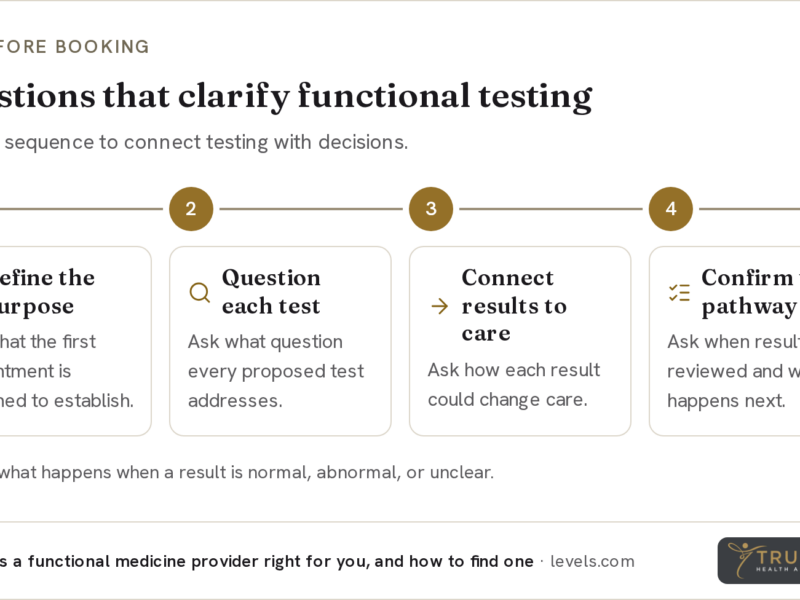 Functional & Holistic Medicine
Functional Medicine Doctor in San Antonio, TX: What to Verify Before Booking
Choose functional medicine care in San Antonio by checking credentials, testing, costs, visit format, and follow-up before booking.
Read article Functional & Holistic Medicine
Functional Medicine Lutz: How to Verify Fredericksburg Care Before Booking
Assess functional medicine care from Lutz, verify Fredericksburg access, prepare questions, and understand potential costs.
Read article