

Functional & Holistic Medicine
Functional Medicine Lutz: How to Verify Fredericksburg Care Before Booking

Start with the decision a Lutz search should answer
A Lutz search for functional medicine should help you decide whether to make a qualified inquiry, not lead you to assume that a search result proves local access, personal suitability, or a treatment recommendation. If you are dealing with unexplained fatigue, brain fog, low mood, poor sleep, weight that will not change, or metabolic concerns, the useful question is whether a particular clinician can evaluate your situation within an appropriate medical scope.
Fredericksburg-based care may be worth exploring only after you understand how access would work from Lutz. A practice’s location, video follow-up options, licensing requirements, visit structure, testing process, and cost policy all affect whether the arrangement is practical for you. None of those details should be filled in from the search phrase alone.
Use this guide as a verification path:
- Define what functional medicine may examine and what it cannot establish without evaluating you.
- Assess the clinician’s license, credentials, safeguards, and approach to testing.
- Ask how Fredericksburg visits and video follow-up would work from Lutz.
- Prepare the records, medication details, symptoms, and questions that make an initial conversation useful.
- Request the full cost picture before you commit to visits, testing, or treatment.
A clear inquiry gives you something more useful than a broad promise: it shows whether the care model, access arrangements, clinical boundaries, and financial expectations fit your situation.
Understand what functional medicine is designed to examine
Functional medicine is described as a systems-based, patient-centered model that often combines advanced diagnostics with personalized lifestyle and nutrition strategies to address possible root causes. Functional medicine physicians use a holistic, patient-centered approach to identify and address possible root causes of disease, while considering how genetic, environmental, and lifestyle factors may interact to influence health and disease.
The model focuses on identifying possible root causes rather than only suppressing symptoms. Possible underlying factors may include gut issues, inflammation, toxins, hormone imbalance, nutrient status, or deficiencies. Those categories are areas for clinical questioning, not explanations for your symptoms by themselves. Fatigue, weight change, poor sleep, or brain fog can have more than one possible explanation, and a general list cannot determine which factors apply to you.
An initial conversation should therefore connect each proposed question or test to a clinical concern. Ask what the clinician is trying to understand, what information would change the plan, and what other explanations still need attention. A careful answer should leave room for uncertainty rather than turning a symptom into a diagnosis.
A functional medicine intake is described in one comparison as running 45 to 90 minutes and covering your full health history, lifestyle, and broader laboratory information.
A longer intake can give you more time to discuss timelines, habits, medications, family history, and prior care, but the value depends on whether the clinician uses that time to form a sensible evaluation plan.
You can ask three direct questions before scheduling:
- What concerns can the clinician evaluate within the scope of the practice?
- Which parts of the visit address symptoms, history, lifestyle, testing, or treatment decisions?
- What will the first visit establish, and what will remain uncertain until later information is available?
Those questions keep the conversation focused on what the appointment is designed to do rather than on the label alone.
Vet the clinician behind the functional medicine label
Certification may strengthen a clinician’s expertise and credibility, but it does not replace or expand the legal scope granted by licensure.
Ask which professional license governs the care you would receive, what the clinician is qualified to diagnose and treat, and how the practice coordinates with your existing clinicians. If a practitioner uses an additional functional medicine credential, treat it as information about training rather than as a substitute for the underlying license.
Responsible functional medicine practice requires evidence-based interventions and safeguards against over-testing, supplement overuse, and work beyond legal authority. Before you agree to testing or a treatment plan, ask:
- What clinical question does each test address?
- What result would change the plan, and what result would not?
- Which tests are standard, and which are considered only when indicated?
- How will supplements, prescriptions, and other clinicians’ recommendations be reconciled?
- What findings would lead to conventional evaluation or referral?
A provider who can explain the boundaries of the process gives you a clearer basis for deciding whether to continue.
At True You Health and Wellness, we intentionally limit the number of patients Dr. Hoff sees so he can focus on their goals. Dr. Hoff designs personalized plans for our patients after comprehensive testing. Dr. Hoff is board-certified in Emergency Medicine and has 20 years of practice.
Those facts are relevant to your provider-fit questions, but they do not determine whether True You Health and Wellness is appropriate for your symptoms or accessible from Lutz. Ask how the stated model applies to your concern, which clinician handles each stage, what comprehensive testing means for your situation, and how we respond when a concern falls outside our scope.
The practical test is simple: you should be able to understand who evaluates you, what information informs the plan, which decisions require another visit, and how ongoing care is coordinated. Use the answers to compare fit, not to assume that a credential or care model settles the decision.
Before contacting True You Health and Wellness, write down the three concerns you most want addressed and the outcome you would consider useful. This gives the initial conversation a concrete starting point without turning your symptoms into a diagnosis. It also lets you ask whether the proposed evaluation matches the concern you actually want help with.
Set expectations from the available evidence
A two-year Cleveland Clinic study examined 1,595 patients treated in a functional-medicine center and 5,657 patients seen in primary care, using the PROMIS questionnaire to assess health-related quality of life. The 1,595 figure measures the functional-medicine group in that study, while the 5,657 figure measures the primary-care comparison group; neither figure describes Lutz residents or predicts your result.
At 6 months, patients seen by the Center for Functional Medicine exhibited significantly larger improvements in PROMIS global physical health than those seen in primary care. At 12 months, patients seen by the Center for Functional Medicine showed improvement similar to that observed at 6 months, but the improvements were not significant compared with those seen in primary care.
Reported improvements may have reflected the care model, patient characteristics, treatment adherence, or belief in the model. Future prospective studies are needed to examine long-term outcomes.
A useful consultation question should turn uncertainty into a decision you can understand. Ask the practice:
- What outcome are we trying to improve, and how will it be measured?
- What alternatives remain available if this approach is not suitable?
- How long will you evaluate the plan before deciding whether it should change?
- What findings would require coordination with primary care or another specialist?
- Which parts of the plan are established medical care, and which parts depend on an individualized discussion?
The study’s findings make expectations more precise. Improvement in one comparison does not establish the cause of the improvement, and a result at one time point does not settle what will happen later. A provider should be willing to discuss those limits while explaining how your own goals, history, and follow-up information would shape decisions.

Ask what each test is meant to change
An initial functional medicine visit may include your individual and family history, environmental factors, and lifestyle or behavioral factors such as smoking, nutrition, and stress management. Standard labs may be used when appropriate, and targeted advanced testing may be considered for metabolic health, hormones, thyroid function, micronutrient status, cardiometabolic risk, or gut-related markers.
Advanced tests are not automatically ordered for everyone. Testing can be tailored to the clinical question to help avoid unnecessary cost. That means your inquiry should focus on purpose rather than on the number or novelty of tests.
Before consenting to testing, ask for answers to these questions:
- What question is this test intended to answer?
- What symptoms, history, or prior result make it relevant to me?
- What will you do if the result is high, low, positive, negative, or inconclusive?
- Is there a standard test that addresses the same question?
- What is the separate charge, and who interprets the result?
- How will the result affect medication, nutrition, lifestyle, referral, or follow-up decisions?
A test becomes more useful when you know what decision it is meant to inform. If no plausible result would change your care plan, ask why it is being considered.
A testing plan should also explain how the practice handles information from your other clinicians. Bring prior results and ask whether the proposed testing duplicates work you have already completed, whether timing or preparation affects interpretation, and how results will be shared with you.
The practice should be able to describe safeguards against over-testing and supplement overuse. Those safeguards matter when you are seeking explanations for symptoms that have continued despite earlier appointments or results that were described as normal. A prior normal result is information to interpret in context; it is not a reason to assume that a new test will reveal a cause.
Your decision boundary is straightforward: proceed only when you understand the question, possible next actions, separate cost, and follow-up plan. Ask for clarification before paying for a test that has no clear connection to a decision.
Verify whether the Fredericksburg care path works from Lutz
Fredericksburg-based care should not be treated as local Lutz care unless True You Health and Wellness confirms that the arrangement is available and appropriate for you. Ask whether you would need to attend an in-person visit, which appointments could occur by video, and whether a Lutz resident can receive each stage of care under the applicable licensing and telehealth rules.
Many of our follow-up appointments can be done by video. Those options do not establish that every appointment, every treatment, or every Lutz resident qualifies for video care.
Before you schedule, ask:
- Is an initial in-person visit required for my concern?
- Can a person located in Lutz receive the proposed evaluation and follow-up through True You Health and Wellness?
- Which appointments must occur at the Fredericksburg office?
- How are laboratory orders, results, prescriptions, and referrals handled for someone outside Fredericksburg?
- What happens if an in-person examination becomes necessary?
Do not infer geographic access from the keyword, a location page, or the availability of a video option. Obtain a direct answer about the complete care path first.
A practical first message can include your location, your main concern, and four access questions: whether an in-person visit is required, which follow-ups can occur by video, whether the proposed care is available to someone located in Lutz, and what information you should provide before booking. Ask who will answer questions about licensing, laboratory logistics, and follow-up. Keeping these issues in one message makes it easier to identify an unanswered boundary before you spend time arranging travel or submitting forms.
Travel time is only one part of access. You also need to know how many visits the proposed evaluation may require, whether follow-up timing can work with your job or family responsibilities, and what happens when symptoms change between scheduled appointments.
Write down the answer to each access question before you compare providers. A practice may be clinically interesting but impractical if the required visit pattern, state eligibility, laboratory logistics, or follow-up arrangements do not work from Lutz. If the practice cannot clearly explain those boundaries, pause the booking decision and ask for clarification.
Prepare an inquiry that can support a real evaluation
A functional medicine consultation becomes more useful when you bring the information that shows how your concerns developed over time. Before your first visit, preparation information is sent; bring your completed medical and lifestyle history questionnaire and relevant records.
Bring past medical records and recent lab results, including normal results, as well as relevant bloodwork, imaging, biopsies, and hospital summaries. Organize the information by date if you can. A short timeline can show when fatigue, sleep changes, weight changes, digestive symptoms, mood changes, medication changes, or major illnesses began.
Normal results still belong in the record because they are part of your medical history. They do not prove that nothing is wrong, and they do not establish that a functional medicine explanation applies. Their value is practical: they help the clinician see what has already been evaluated and decide what questions remain.
Your medication and supplement information should be complete enough for a clinician to reconcile your current routine. Bring a medication list with each medication’s name, dose, and how long you have taken it. Bring every supplement you take.
Keep a symptom journal for one to two weeks, noting energy, digestion, sleep, mood, pain, and relevant habits or patterns. The one-to-two-week period is a preparation window, not a diagnostic test. Record what you notice without changing prescribed treatment on your own.
Prepare your family health history, including autoimmune, thyroid-related, cardiovascular, or metabolic conditions affecting parents, grandparents, or siblings. Include approximate timing when you know it, but do not delay an inquiry because a family detail is incomplete. A partial, honest history is more useful than a polished account that leaves out uncertainty.
A first functional medicine visit may include 60-90 minutes of conversation and 30-60 minutes of intake forms, followed by a testing plan rather than an instant diagnosis. The two figures refer to different parts of the visit; ask the practice what its stated appointment duration includes.
Descriptions of a functional medicine intake range from 45 to 90 minutes and may include broader history, lifestyle, and laboratory information. These published descriptions use different definitions of an intake and a first visit, so do not use either range as a promise about your appointment length.
Prepare written questions such as:
- What will happen during the first appointment?
- What information should I send before arriving?
- When will you explain the testing plan and its cost?
- What decisions wait for lab results?
- How will you communicate results and next steps?
Expect evaluation and planning before treatment conclusions. That sequence gives you a chance to understand the reasoning before you decide whether to continue.
A one-page summary can make the inquiry easier to use. Put your main concerns at the top, followed by when each began, what has changed, what you have already tried, and what question you want answered. Attach the records that support the timeline rather than sending an unorganized collection of documents. Keep a copy for yourself so you can check whether the first conversation addressed each concern.
Request the complete cost picture before booking
Functional medicine visit costs vary based on location, provider expertise, consultation type, and included services. Initial functional medicine consultations are typically more expensive than follow-up visits because they are more detailed and involve personalized planning. Functional medicine visits also tend to run longer, may not be covered the same way by insurance as standard appointments, and may involve recommended testing that is out-of-pocket.
Additional costs may include laboratory testing, health coaching, or subscription-based plans, depending on the provider’s pricing model. The number of visits can also change the total. Ask for separate amounts or estimates for:
- The initial consultation and any required intake process.
- Follow-up visits and result-review appointments.
- Standard laboratory work and targeted advanced testing.
- Medications, supplements, or other recommended items.
- Monitoring, coaching, subscriptions, or care packages.
- Cancellation, payment, reimbursement, and insurance paperwork policies.
A complete answer lets you distinguish the first payment from the likely cost of continuing care. It also prevents a low consultation figure from becoming the only number you use to judge affordability.
A published estimate reports around $460 per hour as the average charge for functional medicine doctors. The $460 figure measures an average hourly charge reported for functional medicine doctors, not the price of a particular appointment, practice, test, or care plan in Lutz or Fredericksburg. Most visits do not last an hour, and some providers offer fixed-price bundles.
Use that figure only as broad context. It should not replace a practice-specific explanation of what the consultation includes, how time is billed, or which services are separate. A bundled price can also mean different things from one practice to another, so ask how many visits, tests, reviews, and support services are included.
The most useful cost question is: “What would I pay at each stage, what is included, and what could be added later?” Ask the practice to distinguish consultation fees, laboratory charges, treatment costs, and follow-up costs before you agree to proceed. Do not begin a plan that you cannot reasonably continue.
Compare any estimate on the same basis. A first-visit figure is not comparable with a package that includes later reviews, and a consultation fee is not comparable with a total that includes testing or treatment. Ask whether each amount is a one-time charge, a recurring charge, or a possible add-on. Then record the likely first payment, the next expected payment, and the conditions that could change the estimate. This turns a vague price question into a usable budget question.

Ask how weight-loss or hormone-related care would be evaluated and monitored
Medical weight-loss decisions should be connected to your history, current health information, and monitoring plan rather than to a medication name alone. Our physician assesses your labs, history, sleep, stress, and medications to create a personalized medical weight-loss plan. Our treatment plans may include medical weight loss, including GLP-1 medications when clinically appropriate.
Those statements describe what True You Health and Wellness offers as a possible process; they do not establish that medical weight loss or a GLP-1 medication is appropriate for you. Ask what information would make treatment unsuitable, which alternatives would be considered, what risks and side effects require attention, and how we will decide whether the plan should continue or change.
For hormone-related concerns, ask the same kind of questions about the clinical reason for evaluation, the information needed before treatment, possible alternatives, follow-up timing, and what findings would lead to referral or coordination with another clinician. Do not treat a symptom list or a search result as a basis for starting medication.
Monitoring is part of the treatment decision, not a detail to discuss after you begin. We monitor patients prescribed GLP-1 medications for response and side effects.
Ask how response will be assessed, which side effects require a prompt call, what laboratory or clinical information will be reviewed, and who should manage concerns between visits. Ask whether a video follow-up is available for your specific situation and whether an in-person examination could become necessary.
A responsible inquiry should produce a clear sequence: evaluation, information gathering, a discussion of options, a decision, and monitoring. If you cannot identify how we will review response or handle adverse effects, do not treat the availability of a medication as a complete care plan.
Put urgent symptoms ahead of provider research
We advise prompt attention for those combinations of symptoms, and we consider a root-cause work-up appropriate for persistent, unexplained fatigue - not for symptoms such as chest pain or shortness of breath.
Seek urgent qualified medical care when symptoms are severe, sudden, or worsening. Do not wait for a functional medicine consultation, a laboratory review, or a provider comparison when immediate evaluation may be needed. Do not stop prescribed medication or delay necessary conventional care while researching a practice.
If your symptoms are persistent but not urgent, gather your history and records and arrange an appropriate clinical conversation. The immediate priority is the level of care your symptoms require, not the label attached to the provider.
Book the next verified conversation
Your next decision should follow the answers you receive about scope, access, testing, monitoring, and cost. If the Fredericksburg care path is available for you from Lutz, the evaluation plan addresses your concerns, and the financial terms are clear, use your prepared records and questions to request an initial conversation. If any of those conditions remain unclear, resolve that uncertainty before committing to care.
A qualified healthcare professional should determine your individual suitability for evaluation or treatment. The purpose of your inquiry is to give that professional accurate information and to give you enough detail to decide whether the proposed process fits your needs. Keep urgent symptoms on an appropriate medical-care pathway rather than waiting for provider research to answer them.
What should I confirm before contacting a functional medicine practice from Lutz?
Can a Lutz resident assume Fredericksburg functional medicine care is available by video?
No. A video option does not establish that every appointment, treatment, or Lutz resident qualifies. Confirm whether you need an in-person visit, which stages can occur by video, how licensing and laboratory logistics are handled, and what happens if an examination becomes necessary.
How can I decide whether a functional medicine test is worth considering?
Ask what specific clinical question the test addresses, what findings would change the plan, whether standard testing could answer the same question, what the test costs separately, and who will interpret it. Testing should support a care decision rather than simply produce more results.
What should I send a clinician if earlier laboratory results were described as normal?
Send the normal results along with other relevant bloodwork, imaging, hospital summaries, medication details, supplement labels, and a symptom timeline. Normal results are part of your history, but they do not establish a diagnosis or prove that additional testing will identify a cause.
When should fatigue be treated as an urgent medical concern instead of a routine functional medicine inquiry?
Seek prompt qualified medical attention if fatigue occurs with chest pain, shortness of breath, fainting, unexplained weight loss, or fevers. Severe, sudden, or worsening symptoms should not wait for provider research, a consultation, or laboratory review.
Next step
Want a doctor who looks for the root cause?
Dr. Brian Hoff sees patients at our boutique, cash-based practice in downtown Fredericksburg, VA, with time to listen and a plan built around you.
More on Functional & Holistic Medicine
See functional medicine Functional & Holistic Medicine
Is Functional Medicine Evidence-Based? How to Evaluate the Research and Care
Learn how to assess functional medicine research, tests, treatments, risks, and care with a qualified clinician.
Read article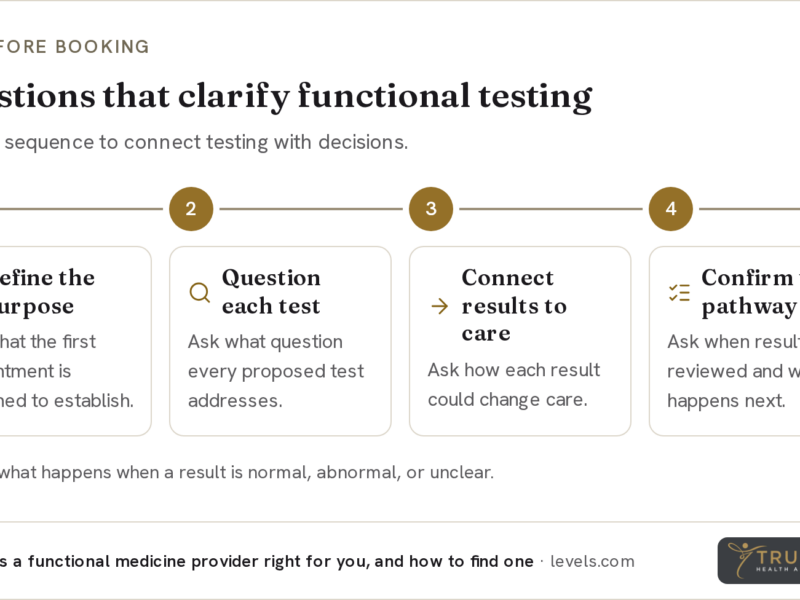 Functional & Holistic Medicine
Functional Medicine Doctor in San Antonio, TX: What to Verify Before Booking
Choose functional medicine care in San Antonio by checking credentials, testing, costs, visit format, and follow-up before booking.
Read article Functional & Holistic Medicine
Women’s Functional Medicine Near Me in Fredericksburg, VA: How to Verify Care Before You Inquire
Compare women's functional medicine near me in Fredericksburg, VA by provider, testing, safety, follow-up, costs, and access.
Read article