

Functional & Holistic Medicine
How to Choose a Functional Medicine Doctor Near Fredericksburg, VA

Prepare for the first functional medicine conversation
Choosing care near Fredericksburg, Virginia is easier when you arrive at the first conversation with a record of what you want clarified. Fatigue, thyroid concerns, Hashimoto’s, digestive symptoms, autoimmune questions, hormonal changes, or metabolic concerns can all be reasons to seek discussion. None of those labels establishes a diagnosis or determines which tests or treatments belong in your care.
A useful first conversation covers your concern, the information already available, and the reasoning behind evaluation, testing, interpretation, and follow-up. That focus helps you assess a practice without assuming functional medicine is universally superior or promising a particular result.
For a reader considering True You Health and Wellness, practical fit also includes the practice’s stated payment model, visit style, access, and continuity. The note below is designed to make those points easier to discuss. It is preparation for a clinical conversation, not individualized diagnosis or treatment advice.
Use this note before you contact a practice:
Concern to discuss: State the main issue in your own words—such as fatigue, a thyroid or Hashimoto’s concern, digestive symptoms, autoimmune questions, hormonal changes, or a metabolic concern. A symptom label is a starting point, not a diagnosis.
Information already available: List prior results or other information you want the clinician to consider. If thyroid testing is part of the discussion, note whether TSH, free T4, or thyroid-antibody results are available; thyroid antibodies can help identify autoimmune thyroiditis, while TSH and free T4 indicate thyroid function.
What you want explained: Ask what the initial history and examination are meant to clarify, why a proposed test addresses that question, and how results within a laboratory reference range would be interpreted. For fatigue, remember that the symptom can have medical, psychiatric, medication-related, substance-related, or physiologic causes, so the conversation should not assume one explanation.
How the relationship would continue: Note how results would be reviewed, how changes in health status or symptom progression would be followed, and how the next part of a plan would be explained. Also note the practice’s payment model, visit style, and access so you can compare the arrangement with your circumstances.
Keep the completed note for the conversation with True You Health and Wellness or another nearby practice. The answers you receive—not a label or a promised outcome—can help you decide whether to continue the discussion.
Define functional medicine in usable terms
Functional medicine is described by the Institute for Functional Medicine as personalized to your health concerns, current conditions, lifestyle, and goals, with nutrition-based interventions forming part of many care strategies. In practical terms, the approach asks how your symptoms, history, habits, existing conditions, and test results fit together rather than treating every symptom as an isolated item.
That description is a care framework, not a diagnosis and not proof that a particular intervention will help you. Your symptoms still need clinical assessment. Your goals still need to be realistic and specific. Any proposed test or treatment still needs a reason that can be explained in ordinary language.
Our goal in functional medicine is to identify root causes of symptoms rather than manage each symptom individually. That goal gives you a useful question to ask: how will the practice connect your concern to an evaluation plan without assuming that the first symptom label is the answer?
A root-cause focus should not mean ignoring standard medical assessment. A sound conversation can include history-taking, examination, established laboratory interpretation, lifestyle discussion, and a decision about whether additional evaluation is justified. You should be able to ask what is known, what remains uncertain, and what would change the plan.
The practical distinction is therefore not “functional” versus “conventional” as a contest. It is whether the clinician explains the reasoning that links your concerns to the next step.
Use the term as a description of an approach, not as a shortcut to a result. A useful explanation should tell you:
- Which part of your history is relevant to the concern you brought.
- Which clinical question the evaluation is meant to answer.
- How lifestyle, nutrition, existing conditions, and test results will be considered together.
- What would make the clinician change the working plan.
If an explanation moves straight from a broad symptom to a fixed cause or a predetermined treatment, ask for the reasoning in between. A clear process matters more than a label that sounds comprehensive.
Use credentials as the first filter
A functional medicine doctor should first be evaluated as a medical professional. WebMD explains that functional medicine doctors complete conventional medical school training and may then choose to practice functional medicine; it also advises checking legitimate education and licensure because standards in the functional-medicine field are not as established.
That gives you a straightforward first filter. Ask who will evaluate you, what medical training and licensure that person holds, and who is responsible for interpreting findings and making clinical decisions. You can also ask whether the person ordering or recommending a test will review the result with you. A polished title or service label cannot answer those questions.
A credential-and-responsibility checklist can come before any comparison of testing menus:
- What clinician will lead your evaluation?
- What medical education and licensure does that clinician hold?
- Who reviews your history, examination findings, and laboratory results?
- Who explains the plan if a result raises a concern?
- How can you ask a follow-up question after the initial discussion?
The answers should identify a clear clinical responsibility, not just a general promise of personalized care. You are looking for a chain from professional qualifications to evaluation, interpretation, and follow-up. If that chain is difficult to identify, pause before treating a broad service list as a reason to proceed.
A local search can make convenience feel like the main criterion, especially if you are balancing work, exercise, family responsibilities, or travel around Fredericksburg. Location still matters, but it should follow the basic credential check rather than replace it.
Compare the clinician’s qualifications, the concerns the practice evaluates, the way testing is explained, and the expected follow-up. Then consider whether the location and visit format are workable for you. A nearby practice that cannot explain responsibility or continuity may be a weaker fit than a practice whose clinical process is clear and practical for your circumstances.
Ask how the first conversation becomes an evaluation plan
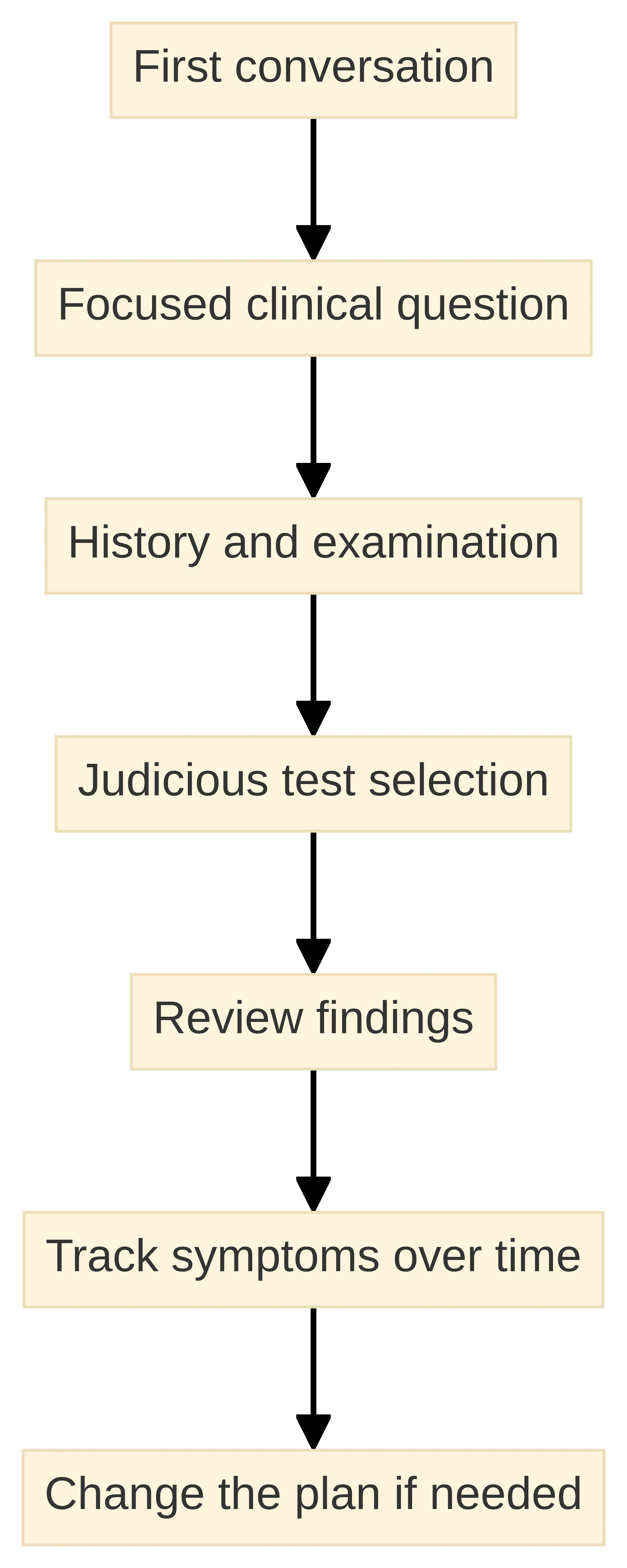
Your first conversation should turn a broad concern into a focused clinical question. Functional medicine is described as considering your health concerns, lifestyle, and goals, while fatigue is a nonspecific symptom associated with medical, psychiatric, medication-related, substance-related, and physiologic causes. An initial fatigue evaluation should consider common and potentially serious causes through a comprehensive history and examination, with tests selected judiciously according to the clinical situation.
Bring a concise account of what you have noticed, when it began, what changes it, what affects your daily life, relevant diagnoses, medicines or supplements, prior results, and what you want the visit to clarify. You do not need to arrive with a self-diagnosis. You need enough detail for the clinician to distinguish a symptom pattern from a conclusion.
An evaluation plan should explain what happens after the first conversation. Follow-up with a functional-medicine provider may include reviewing test results, checking symptom progression, and developing a personalized health action plan.
Ask the following before you agree to a plan:
- What question are we trying to answer first?
- Which parts of my history or examination make that question relevant?
- What result would change the next step?
- When will we review the findings and discuss whether the plan needs to change?
- How will you track symptoms or other changes over time?
These questions protect you from a visit that produces a long list of possibilities without a path for deciding what to do next. A plan can remain flexible, but its reason and next review should be understandable.
A short preparation note can make the opening discussion more useful. Include:
- Your main concern in one sentence.
- The timeline and pattern of the symptoms.
- Relevant diagnoses, medicines, supplements, and prior tests.
- Changes in sleep, digestion, weight, mood, activity, or daily function that seem connected.
- The decision you want the visit to help you make.
Keep observations separate from conclusions. “I have an afternoon energy crash” describes an experience; “my adrenal glands are failing” states a cause that has not been established. That distinction gives the clinician room to consider several explanations.
Turn that note into a concern-specific comparison rather than a general symptom list. Use three short columns—“bring,” “ask,” and “listen for”—and complete only the row that matches your reason for contact:
- Thyroid or Hashimoto’s: Bring dates and copies of any TSH, free T4, or thyroid-antibody results you already have, along with relevant symptoms and medicines. Ask which results address thyroid function, which may help identify autoimmune thyroiditis, and how they will be interpreted together. Listen for a distinction between evidence of autoimmunity and measurements of thyroid function, rather than an attempt to make one result carry every conclusion.
- Fatigue or an “adrenal fatigue” concern: Bring the timing and pattern of tiredness, including afternoon crashes or unrefreshing sleep if those describe your experience, plus relevant medicines, sleep changes, and effects on daily activity. Ask which common or potentially serious causes need consideration and how history, examination, and judicious testing fit together. Listen for an evaluation that treats fatigue as nonspecific and “adrenal fatigue” as a nonformal symptom label, not an established diagnosis.
- Gut symptoms: Bring the timing, bowel-pattern changes, discomfort, food-related observations, medicines, and changes over time. Ask what pattern is being evaluated, what findings would call for another type of care, and how follow-up will assess it. Listen for a plan that uses the description to guide evaluation without treating a functional gastrointestinal label or food theory as proof of cause.
After the conversation, write down the clinician’s working question, the reason for any proposed test, what result would alter the next step, and when the explanation will be revisited. This makes the practice’s reasoning easier to compare across visits and helps you notice whether the answer stayed connected to your concern. It also keeps the record useful if you are comparing care while balancing work, family, training, or travel around Fredericksburg.
If an answer remains broad, record what is still unanswered rather than filling the gap with a diagnosis of your own. That unanswered question can become the most useful subject of the next conversation.
Treat testing as a reasoned step, not a shopping list
Testing for fatigue should follow a clinical question rather than a desire to collect every available measurement. Fatigue is a nonspecific symptom with medical, psychiatric, medication-related, substance-related, and physiologic causes. An initial evaluation should consider common and potentially serious causes, include a comprehensive history and examination, and use tests judiciously after the clinical situation and possible warning signs have been considered.
That principle applies beyond fatigue. Ask what each test is meant to clarify, what its result could change, and how the result will be interpreted with your history. A larger panel is not automatically a more useful evaluation. A smaller set of well-explained tests may provide a clearer decision path.
A testing checklist can keep the conversation focused:
- What clinical question does this test address?
- Why is the test appropriate for your symptoms, history, or examination?
- What would a high, low, or unremarkable result mean in your situation?
- Could the result be affected by medication, timing, illness, or another condition?
- What will happen if the result does not change the working plan?
- When and by whom will the result be reviewed?
The phrase “advanced testing” should still come with an explanation. Ask how a proposed test fits your particular question rather than treating the availability of a test as a reason to order it.
At True You Health and Wellness, we allow for longer visits and emphasize advanced testing with physician-guided plans tailored to individual health needs. Those are features of our stated model, not a promise that additional testing will identify a cause or improve an outcome for you.
The useful comparison is whether the clinician can connect the testing choice to your history and explain what the result will do in the plan. You can ask whether the proposed testing is intended to establish a diagnosis, assess a known condition, clarify an uncertain finding, or guide a later discussion.
Testing also creates a responsibility to explain limits. Ask whether a result can be interpreted on its own or only alongside your history and examination. Ask what the clinician will do with an unexpected result, a result that falls within the laboratory reference range, or a result that does not match your symptoms.
A useful answer does not need to predict the outcome. It should identify the decision that the result may inform and the follow-up needed to discuss it. If you cannot tell what a proposed test is meant to change, ask that question before treating the test as the next step.
Use thyroid and Hashimoto’s questions to test the quality of interpretation
Hashimoto thyroiditis is an autoimmune disorder that can present with thyrotoxicosis, euthyroidism, or hypothyroidism. Thyroid antibodies can help identify autoimmune thyroiditis, while TSH and free T4 indicate thyroid function. Those facts show why a thyroid conversation needs more than a symptom list or a single antibody result.
Ask how the clinician separates three related but different questions:
- Is there evidence of an autoimmune process involving the thyroid?
- What do the current thyroid-function measurements indicate?
- How do the results fit your symptoms, history, medicines, and other clinical findings?
A symptom such as fatigue does not, by itself, establish Hashimoto’s. The quality of the conversation lies in explaining how the pieces fit together.
Thyroid test patterns require clinical interpretation. TSH and T4 are interpreted together; high TSH indicates hypothyroidism, and low T4 supports a thyroid-origin problem. Low TSH with high free T4 can occur with hyperthyroidism or other thyrotoxicosis. Thyroid antibodies address a different question from the measurements that indicate actual thyroid function.
These patterns are not a personal interpretation of your results. They are examples of why you should ask what a measurement means in context, what alternative explanations remain, and whether the next step is repeat testing, another evaluation, treatment discussion, or observation.
A useful thyroid consultation should leave you knowing what each result measures, what it does not measure, and what decision follows from the combined picture.
Take these questions to a thyroid discussion:
- Which result addresses thyroid function, and which addresses possible autoimmunity?
- How do the results fit together rather than standing alone?
- What symptoms or examination findings make the results more or less relevant?
- What would warrant repeat testing or another evaluation?
- What follow-up is needed to decide whether the working plan changes?
You do not need to interpret a thyroid panel yourself. You do need an explanation that separates a test result from the diagnosis or treatment decision that may follow.
Keep fatigue and gut concerns clinically bounded
“Adrenal fatigue” is not a formal medical diagnosis. At True You Health and Wellness, we associate the term with symptoms such as exhaustion, poor stress tolerance, afternoon crashes, and unrefreshing sleep, but those symptoms still need a broader clinical discussion. Use the phrase as a description of what you are experiencing, not as a conclusion about the cause. Ask what recognized medical explanations need to be considered and how they will be evaluated.
Gut concerns also need a specific description. Recognized functional gastrointestinal disorders include functional dyspepsia, irritable bowel syndrome, bloating, constipation, and diarrhea. Naming the pattern can help you describe what is happening, but it does not decide which evaluation applies to you.
Before a digestive-health conversation, record the symptom pattern, timing, changes in bowel habits, food-related observations, pain or discomfort, sleep, medicines, and any sign that the problem is worsening. Ask what the clinician is evaluating, what findings would require a different type of care, and how follow-up will assess the pattern. Avoid treating a functional gastrointestinal label, a food theory, or an “adrenal” explanation as a substitute for medical evaluation.
This bounded approach lets you discuss fatigue and gut symptoms without dismissing them or turning them into diagnoses before clinical assessment.
Use symptom descriptions that help a clinician make distinctions. Note whether the concern is constant or episodic, what happens before and after it, whether it affects work or activity, and whether it is changing. For digestive symptoms, note timing, bowel-pattern changes, discomfort, and food-related observations without assuming that one observation proves a cause.
Bring worsening or disruptive patterns into the conversation rather than waiting for a label to feel certain. The purpose of the record is to make the pattern easier to discuss; it is not to establish the diagnosis yourself.
Compare your concerns with True You Health and Wellness’s stated model
At True You Health and Wellness, we offer boutique, cash-based functional and integrative medicine in Fredericksburg, Virginia. Our cash-based model allows for longer visits and clinically chosen testing, and we emphasize advanced testing with physician-guided plans tailored to individual health needs.
For your comparison, connect those stated features to your own priorities. A longer visit may matter if you need time to explain a complicated history. Clinically chosen testing may matter if you want a reason for each proposed measurement. A physician-guided plan may matter if you want a clinician to connect findings to next steps. None of those features determines whether our practice is suitable for your particular concern, so use them as questions to explore rather than as assurances.
We also offer direct access to physicians and follow-up that tracks changes in health status.
Our model may fit you if you want a conversation that connects symptoms, history, testing, and goals over time. Ask how your concern would enter our process, who would review the findings, and how follow-up would help decide what happens next.
Use the same questions for any practice you consider. The point is not to accept a label; it is to see whether the stated care model matches the clinical conversation you need.
This list describes our care model. It does not determine whether a particular service, test, or plan is appropriate for you. Use it to decide which practical and clinical questions you want answered before moving forward.
Check how results become an ongoing plan
At True You Health and Wellness, we offer direct access to physicians and follow-up that tracks changes in health status.
We also explain laboratory results, connect them to symptoms, and recommend parts of a plan based on those results through Dr. Hoff’s care model. If you contact us, ask how that explanation will work for your concerns and how changes will be tracked. You should know whether follow-up is intended to answer a defined question, assess a response, revisit an uncertain finding, or decide that another evaluation is needed.
A follow-up record can keep the next conversation focused. Use four headings:
- What symptoms or measurements are being tracked?
- What change would count as meaningful for your plan?
- When will the plan be reviewed?
- What question should you bring to that review?
This record is a practical aid for organizing your next conversation. It does not predict an outcome or replace clinical judgment. A plan can change when new information appears, but you should understand why it changed and what question the next step is meant to answer.
Continuity also means knowing what happens when the original explanation does not hold. Ask whether a new symptom, an unexpected result, or a lack of change would lead to a revised question, additional evaluation, or a different care pathway. You should not have to infer the next decision from a general promise of ongoing support.
Before you leave a visit, repeat the working question in your own words and note the next review point. That simple step gives you something specific to revisit rather than a collection of disconnected recommendations.
Confirm the practical fit before proceeding
Practical fit includes the payment model, visit structure, testing process, communication, and follow-up—not only the clinical philosophy. At True You Health and Wellness, we operate as a cash-based practice in Fredericksburg, Virginia, and this model allows for longer visits and clinically chosen testing.
Before proceeding, ask what the initial visit includes, how testing is handled, how follow-up is arranged, and what costs apply to each part of the process. You do not need to decide based on a broad service list. You need enough practical information to know whether the arrangement fits your time, budget, location, and expectations.
A practical fit check can come before you make contact:
- Can you describe the main concern you want evaluated?
- Are you looking for an ongoing physician-guided conversation or a single answer?
- Do you understand that a symptom label does not establish a diagnosis?
- Are you prepared to ask why a test or treatment is being considered?
- Can a cash-based structure fit your circumstances?
- Do you know what you want the first conversation to clarify?
If your answers are clear, write down three questions and the most useful history details before contacting a practice. If your answers are not clear, begin with the concern itself rather than choosing a diagnosis for yourself.
Compare practices using the same practical questions:
- What is the payment arrangement?
- How much time is available for the initial discussion and later review?
- Who interprets test results and explains the plan?
- How are symptoms or other changes tracked?
- What happens when a result does not answer the original question?
- Can the location and communication process work with your schedule?
This comparison keeps convenience, cost, access, and continuity in the same decision rather than letting one attractive feature decide the whole choice.
Request help with an order
An order-help request addresses a practical question about whether order-related help is appropriate; it is not the same as selecting a functional medicine evaluation. Keep the request narrow and describe the issue plainly. Include the relevant order context, what you need clarified, and the best way for the practice to respond.
An order-help request does not place an order, take payment, or reserve an appointment. That boundary matters because you may still be comparing clinicians, deciding whether the care model fits, or preparing questions about your symptoms. Treat the request as a way to clarify an order-related matter, not as a substitute for diagnosis, treatment planning, or a suitability decision.
Preparation for an order-related question can follow this list:
- State what you are trying to clarify.
- Include only the details needed to identify the issue.
- Avoid presenting a suspected diagnosis as an established fact.
- Keep separate questions separate so each can receive a clear response.
- Keep health decisions separate from an order question.
If your main need is to compare care in Fredericksburg, return to the credentials, testing, interpretation, follow-up, and practical-fit questions above before treating an order question as your next clinical step.
Choose the next conversation without self-diagnosing
Choosing care near Fredericksburg, Virginia is a decision about clinical reasoning and practical fit. Start with legitimate medical education and licensure, then ask how your concerns become an evaluation plan. Look for a reason behind each test, an explanation of what results measure, and a follow-up process that tracks the questions that matter to you.
At True You Health and Wellness, we offer cash-based functional and integrative medicine in Fredericksburg, with longer visits, physician-guided plans, clinically chosen testing, direct physician access, and follow-up that tracks changes in health status. Those features may fit what you want from care, but a qualified healthcare professional must decide whether a particular evaluation or treatment is suitable for your circumstances.
Bring your symptoms as information, not as a diagnosis. Bring questions about testing, interpretation, continuity, and cost.
Functional medicine
Want a doctor who looks for the root cause?
Dr. Brian Hoff sees patients at our boutique, cash-based practice in downtown Fredericksburg, VA — with time to listen and a plan built around you.
More on Functional & Holistic Medicine
See functional medicine Functional & Holistic Medicine
Find a Naturopath Near Me: 4 Steps to Choose the Right One
Discover how to find a qualified naturopath near me with essential steps for your health journey.
Read article Functional & Holistic Medicine
What Is a Functional Medicine Doctor and Why It Matters
Discover what a functional medicine doctor is and how they address your unique health needs.
Read article Functional & Holistic Medicine
5 Steps to Find Your Ideal Functional Medicine Practitioner
Discover how to find the right functional medicine practitioner for your unique health needs.
Read article