

Functional & Holistic Medicine
Women’s Functional Medicine Near Fredericksburg, VA: How to Verify Care Before You Inquire

Start with the decision your search needs to answer
A local functional medicine inquiry should help you decide whether the proposed evaluation fits your concerns, expectations, and practical limits - not convince you that a label explains your symptoms. Functional medicine may be useful when symptoms have not fully resolved after conventional evaluation or do not point to one clear diagnosis. That possibility is a reason to ask better questions, not a diagnosis of fatigue, brain fog, low mood, poor sleep, weight change, digestive symptoms, thyroid concerns, or hormone-related changes.
Women’s functional medicine focuses on understanding possible root causes of health issues and how systems in the body connect. Functional medicine considers nutrition, sleep, stress, gut health, hormones, lifestyle, environment, and genetics as factors that can influence health. A provider may therefore ask about several parts of your history instead of limiting the conversation to the symptom that brought you in.
A functional medicine intake runs 45 to 90 minutes, covers full health history and lifestyle, and may include fasting insulin, full thyroid markers, sex hormones, and inflammatory markers. The range describes a care model, not a promise about every local appointment. Ask what the first visit includes, what it costs, and what decisions can actually be made at that stage.
Use four questions to frame your search:
- What concerns does the clinician evaluate, and what remains outside the practice’s scope?
- What information, examination, or testing would shape the next decision?
- How will findings become a plan, and who coordinates with your existing clinicians?
- What will you pay for the first visit, testing, follow-up, and any later care?
Those questions keep your inquiry grounded in a care path you can understand rather than in the functional medicine label alone.
Separate broader integrative-use evidence from the local search
A national poll gives broad context about integrative medicine use, but it does not tell you how common women’s functional medicine is near Fredericksburg or which local patients seek it. Among adults age 50-80 in the cited poll, 66% reported using at least one integrative medicine strategy; 38% were current users, 28% had used one in the past, 21% were interested in trying them, and 13% had neither used nor expressed interest. These percentages describe United States adults age 50-80 in that poll, not patients in Fredericksburg, Stafford, Spotsylvania, Quantico, Richmond, King George, or Northern Virginia.
The same poll found that women were more likely than men to currently use integrative medicine strategies: 44% of women compared with 31% of men. The comparison describes current use in the cited poll, not a diagnosis, a treatment result, or a measure of demand for a specific practice. It also does not establish that a local provider is appropriate for your symptoms.
Treat the survey as background for your question, not as proof that a local option will fit. Your decision should rest on the clinician’s qualifications, the concerns the provider handles, the evaluation process, the follow-up plan, and the full cost of care. If a website uses broad popularity or interest to create urgency, return to the more useful question: can the provider explain what it will evaluate and what happens after the evaluation?
Your own search may include women in different life stages, busy professionals, athletes, military families, and other adults with concerns that overlap with women’s health. Those categories do not determine whether a particular care path fits you. Use them only to make your inquiry specific: explain the symptoms, goals, prior evaluations, and practical constraints you want the provider to consider.
Check what the provider actually evaluates
A functional medicine evaluation typically begins with a detailed review of your medical history, environmental factors, lifestyle, emotional health, and family background before a personalized plan is developed. That broader history can help you see whether the provider is prepared to discuss the pattern you are experiencing rather than only one isolated complaint.
A functional medicine provider may use comprehensive blood panels and physical assessments, then recommend further testing based on your symptoms and results. Further testing can include gut health assessments, food sensitivities, genetic testing, hormone levels, and other advanced panels. Those possibilities are not a standing list of tests you need; ask what each proposed test is intended to establish, how its result could change the plan, and what it will cost.
The comparison below shows why you should ask about the intended scope of a visit instead of assuming that every appointment follows the same format:
| Question | Standard annual physical | Functional medicine intake |
|---|---|---|
| Time | A standard annual physical runs 15 to 20 minutes. | A functional medicine intake runs 45 to 90 minutes. |
| Main review | It checks basic markers and flags findings outside the normal reference range. | It covers full health history and lifestyle. |
| Laboratory approach | Testing is connected to the basic markers being checked. | The intake may include fasting insulin, full thyroid markers, sex hormones, and inflammatory markers. |
Functional medicine uses a systems-based approach that seeks to address underlying causes, symptoms, and functional imbalances in interconnected biological networks. That description explains the model’s intended way of organizing information; it does not identify your personal cause or predict what testing will show.
Ask these questions before you commit to an evaluation:
- Who reviews your complete history, and how much time is reserved for that review?
- Which symptoms or health goals fall within the clinician’s scope?
- Which tests are standard for the provider, and which are ordered only when your history or results support them?
- What does a result change: the diagnosis being considered, the treatment discussion, the need for referral, or simply the next question?
- How will your primary-care clinician, gynecologist, endocrinologist, gastroenterologist, or another specialist be involved when coordination is needed?
A clear answer should connect the proposed evaluation to a decision. If a test is presented without a purpose you understand, pause and ask what it is meant to establish before agreeing to it.
You can also ask how the provider handles an inconclusive result. A useful response should explain whether the next step would be more history, a different evaluation, monitoring, referral, or no change. That keeps testing tied to clinical decisions rather than treating a longer test list as a care plan.
Start with the concern you need evaluated
The clinician’s qualifications and scope determine what your inquiry can reasonably cover. Our physician, Dr. Brian C. Hoff, graduated from Georgetown University School of Medicine and served as Chief Resident. Dr. Hoff is board-certified in Emergency Medicine with 20 years of practice. Those credentials describe education, residency leadership, specialty certification, and experience; they do not by themselves determine whether a particular evaluation or treatment is appropriate for you.
Ask who will personally evaluate you, who orders and interprets testing, who prescribes if medication is considered, and who handles follow-up. You can also ask how the provider manages concerns that require primary care, gynecologic care, endocrinology, gastroenterology, mental-health care, or another specialist. A functional primary care model may include preventive visits, chronic disease management, medication prescribing, laboratory testing, referrals, and care coordination, with visits often longer and follow-up more frequent. Whether a particular provider provides each service is a separate question.
A summary reports that, in a cohort of more than 7,000 patients, 31% achieved clinically meaningful improvements using validated NIH PROMIS measures. The 31% describes the proportion reported in that summary’s cohort, not the chance of improvement for you and not the performance of a Fredericksburg practice. Use such figures to ask how a provider defines a meaningful result, how it monitors progress, and what happens when the intended result does not occur.
For a women’s health inquiry, make the scope question concrete. Ask whether the provider evaluates the specific concern you want to discuss, how it distinguishes a concern that can be managed within its service from one requiring another clinician, and how a referral would affect follow-up. If your questions involve cycle-related changes, perimenopause, menopause, thyroid concerns, digestion, sleep, mood, fatigue, or weight, name the concern rather than relying on a broad service label.
A useful clinician-scope checklist includes:
- Medical training, board certification, and the conditions or concerns the clinician routinely evaluates.
- The difference between services the clinician personally provides and services handled through referral.
- The process for reviewing medications, supplements, prior diagnoses, and previous treatment responses.
- The method for communicating with other clinicians when care overlaps.
- The point at which persistent, worsening, or unusual symptoms require another type of evaluation.
You are not looking only for a credential. You are checking whether the clinician’s training, scope, and coordination process match the question you need answered.
Follow that concern through evaluation and follow-up
After you identify the concern and the clinician’s stated scope, trace the proposed path from the first conversation to results, decisions, monitoring, and follow-up. An initial functional medicine visit may lead to lab orders and preparation work; a later results visit may be used to discuss the plan, with coaching between appointments. Ask when results are reviewed, whether you receive an explanation of findings, and which decisions wait until the results visit.
A typical first conventional visit averages about 18 minutes, while a first functional medicine visit is usually 60 minutes or more. The comparison describes visit length, not clinical quality or outcome. Longer time can give you more room to discuss a timeline, medications, lifestyle, and goals, but you still need to know what the clinician will do with the information.
We make treatment decisions after laboratory results are received, typically at a second visit that can be conducted by video. Many of our follow-up appointments can be completed by video. Confirm that the format and sequence that fit your situation are available when you inquire.
Ask the provider to explain the pathway in plain language:
- What happens during the first appointment?
- Which laboratory work, if any, may occur that day, and what happens if same-day work is not possible?
- When and how will results be reviewed?
- Which treatment decisions wait for the results visit?
- How are changes monitored after the plan is agreed upon?
- What can be handled by video, and which visits require an in-person appointment?
- How are referrals, outside records, and communication with other clinicians handled?
A follow-up plan should give you a sequence you can repeat back: initial history, appropriate evaluation, results discussion, a defined decision, and a way to reassess. If the process ends with testing but no clear results conversation, ask what comes next before booking.
Also ask what happens between visits. Find out how you receive results, whom you contact with a question, whether a medication or supplement change requires a separate discussion, and when monitoring is reviewed. These details help you judge whether the proposed pathway fits your work schedule, travel needs, family responsibilities, and preference for in-person or video care.

Prepare an inquiry that gives the clinician useful information
Your preparation can make an initial inquiry more focused without turning your notes into a self-diagnosis. Complete the intake questionnaires and describe your symptoms, medical background, lifestyle, and goals in enough detail for the clinician to understand the question you want answered. At Parsley, the example questionnaire takes about 30 minutes and covers symptom history, medical background, lifestyle, and goals; another provider may use a different form and time requirement.
Bring a complete list of medications and supplements with doses. Supplements can interact with treatment, and some can distort laboratory results. Include prescription medicines, nonprescription products, vitamins, minerals, herbal products, hormone products, and anything you take intermittently. Photographing labels can be easier than reconstructing names and doses from memory. Do not stop a prescribed medicine or supplement just to prepare for an appointment; the medication question belongs in a qualified clinical discussion.
Gather past laboratory work and medical records, ideally from 2 to 3 years back, before a functional medicine appointment. Records can include prior blood work, imaging reports, specialist notes, medication changes, and relevant diagnoses. You do not need to decide which results matter. Bring the material so the clinician can decide what belongs in the evaluation.
Write a symptom timeline with four parts:
- When each concern began or changed.
- What was happening around the onset, such as an illness, medication change, pregnancy, major stress, sleep disruption, or other event you consider relevant.
- What makes the concern better, worse, or different.
- What you have already tried and what happened afterward.
Pick your top three goals before a functional medicine appointment. Goals might include understanding a persistent pattern, deciding what evaluation is appropriate, clarifying a prior result, or making a plan for follow-up. Keep each goal concrete enough to discuss. A goal such as feeling better may need a more specific conversation about sleep, energy, mood, digestion, weight, cycle-related changes, or daily function.
Prepare questions about the appointment itself as well as your symptoms:
- Who will review the information I submit?
- What records should I send before the appointment?
- What will the first visit decide, and what will wait for later results?
- Which services or tests are separate charges?
- How will you coordinate with my existing clinicians?
This preparation gives you a record of your concerns and gives the clinician material for a more precise conversation. It does not tell you what diagnosis or treatment you should receive.
Compare the complete local care pathway
The practical fit of local care includes the address, appointment format, availability, testing sequence, and total cost - not only the subject of the consultation. We evaluate and treat perimenopause and menopause at 904 Princess Anne St, Suite 207 in downtown Fredericksburg, beginning with a 60-minute appointment and laboratory work. Treat that description as a starting point for your inquiry about the care you are considering, then ask which details apply to your concern and appointment type.
If you would travel from Spotsylvania, Stafford, Quantico, Richmond, King George, or Northern Virginia, include travel time, parking, work obligations, family responsibilities, and the possibility of video follow-up in your decision. A local address does not answer whether appointments are available when you need them or whether every part of care can be delivered remotely.
Functional medicine reimbursement may be limited or nonexistent, so ask about payment and reimbursement before booking. Do not leave cost as a single question about the first visit. Ask for the complete pathway:
- The fee for the initial appointment.
- Whether laboratory work is included, performed separately, or billed by another facility.
- The cost of a results visit and later follow-up visits.
- Whether video appointments have the same or a different fee.
- Whether the provider bills insurance at all, accepts any network arrangement, or operates outside your plan.
- Whether you may submit documentation for possible out-of-network reimbursement.
- Which services, tests, medications, or programs create additional charges.
- What payment is due before care begins and what happens if you decide not to continue.
Ask these questions directly when you inquire:
- Is the appointment in Fredericksburg, by video, or a combination of both?
- What availability is offered for the first visit and the results visit?
- Which laboratory work is expected, and who charges for it?
- What is the estimated total cost through the first treatment discussion?
- Is insurance billed, and if not, what documentation is available for your plan?
- Are follow-up, monitoring, referrals, and coordination included or charged separately?
A simple comparison sheet can keep the answers usable. Create five rows - scope, first evaluation, testing, follow-up, and cost - and three columns: the provider’s answer, what remains unclear, and your next question. Record the address and visit format at the top. This gives you an immediate way to distinguish a clear care pathway from one that needs more information without ranking providers by an unsupported label.
Clear answers let you compare the full care pathway with your budget and schedule. They also prevent an inexpensive-looking first appointment from becoming an unclear series of later expenses.
Use study findings to set outcome boundaries
Functional medicine claims should be separated from what a study actually measured. A Cleveland Clinic source reported that earlier support for the functional medicine model had been primarily anecdotal, based on case reports, or based on targeted interventions. The same source reported an association between the functional medicine model and improved health-related quality of life; that association does not establish an individual outcome.
The cited study provides useful detail, but the detail belongs to the study population and its measures. In a study of 398 patients seen at the Center for Functional Medicine, PROMIS physical-health scores improved from 46.18 (8.67) at baseline to 47.77 (8.15) at 6 months; the comparison with a Family Health Center was statistically significant. At 6 months, the Center for Functional Medicine cohort had a greater mean PROMIS physical-health score change than the Family Health Center cohort: 1.59 [6.29] versus 0.33 [6.09] T-score points in 398 patients. The reported comparison had a P value of .004.
The study also reported that 123 of 398 patients in the Center for Functional Medicine cohort, or 30.9%, improved their PROMIS physical-health scores by 5 or more points, compared with 88 of 398 patients in the Family Health Center cohort, or 22.1%; the reported number needed to treat was 11. The 30.9% and 22.1% figures measure patients reaching that study-defined score change in their respective 398-patient groups. They do not measure symptom relief for every person or the likely result of a local consultation.
At 12 months, PROMIS physical-health scores at the Center for Functional Medicine improved from 45.90 [8.33] at baseline to 47.50 [8.49] in 220 patients, but comparisons with the Family Health Center were not significant. The 12-month comparison therefore does not support a simple claim that the functional medicine model was superior to the comparison setting at that point.
The study authors cautioned that functional-medicine patients may differ from primary-care patients, may be more motivated or engaged, and may have unmeasured factors that affected the reported outcomes.
Use that distinction during an inquiry. Ask:
- What outcome will you track for my concern?
- How will you define meaningful change?
- When will we reassess whether the plan is helping?
- What will happen if the result is unchanged, uncertain, or not what we expected?
- What evidence supports the proposed test or intervention for the specific question being addressed?
A provider can describe a model, a study can report an association, and a clinician can still need to decide whether a particular option fits your history. Keep those three statements separate.

Protect the current care plan while you compare
Your existing medications and supplements remain part of the clinical picture while you compare providers. Continue prescribed medications and supplements unless your current healthcare provider advises otherwise, and discuss any medication changes collaboratively with qualified clinicians. Functional medicine works alongside conventional care, so an inquiry should add a coordinated conversation rather than prompt you to abandon established treatment on your own.
Bring your current medication and supplement list to the inquiry, including doses and the reason you take each item if you know it. Tell every clinician about changes, side effects, new products, and concerns about interactions. If a proposed plan would alter a medication, ask which qualified clinician is responsible for that decision, how the change will be monitored, and how your existing prescriber will be involved.
Do not use a new test result, online symptom list, or supplement recommendation as a reason to make an unsupervised medication change. Keep the current plan in place until the appropriate clinician gives you different instructions.
Put urgent fatigue symptoms ahead of provider research
Persistent fatigue deserves clinical attention before you spend time comparing providers. If fatigue does not improve after several weeks, contact a healthcare provider; evaluation may include questions about sleep, daily activities, appetite, and exercise, a physical examination, and laboratory tests.
Seek prompt qualified medical attention for fatigue with chest pain, shortness of breath, fainting, unexplained weight loss, or fevers. Those symptoms should not wait for a website comparison, a routine inquiry, or a future functional medicine appointment. If symptoms are severe or you believe you may be facing an emergency, use the appropriate immediate medical service.
If you are not facing an urgent situation, write down when the fatigue began, how it affects daily function, and any accompanying changes before contacting a provider. Keep taking prescribed medications unless your current healthcare provider advises otherwise. The first priority is timely qualified care; provider comparison comes after that priority is addressed.
Decide where your concern belongs next
Start with the concern you want evaluated rather than with the functional medicine label. For persistent fatigue, brain fog, low mood, poor sleep, or weight that has not changed despite being told your labs are normal, record when each concern began, what affects it, your medications and supplements, prior test results, and your three goals. Bring those details to the inquiry without deciding the cause in advance.
For cycle-related changes, perimenopause, menopause, thyroid concerns, digestion, sleep, mood, fatigue, or weight, ask whether the clinician evaluates that specific concern and what falls within the practice’s scope. When a concern may overlap with primary, gynecologic, endocrinology, gastroenterology, mental-health, or other specialty care, ask how the practice handles referral, records, and follow-up coordination.
Then ask what evaluation is proposed, what the results could inform, when decisions are made, and how progress is monitored. Confirm any video option and complete cost before agreeing to an appointment. These questions help distinguish a concern that can be discussed with the practice from one that needs another clinical route; they do not determine a diagnosis or treatment plan.
If symptoms are urgent or severe, seek immediate qualified medical help rather than waiting while you compare providers. Otherwise, use the stated scope and next-step explanation to decide whether to make an inquiry or seek another clinician.
Next step
Want a doctor who looks for the root cause?
Dr. Brian Hoff sees patients at our boutique, cash-based practice in downtown Fredericksburg, VA, with time to listen and a plan built around you.
More on Functional & Holistic Medicine
See functional medicine Functional & Holistic Medicine
Is Functional Medicine Evidence-Based? How to Evaluate the Research and Care
Learn how to assess functional medicine research, tests, treatments, risks, and care with a qualified clinician.
Read article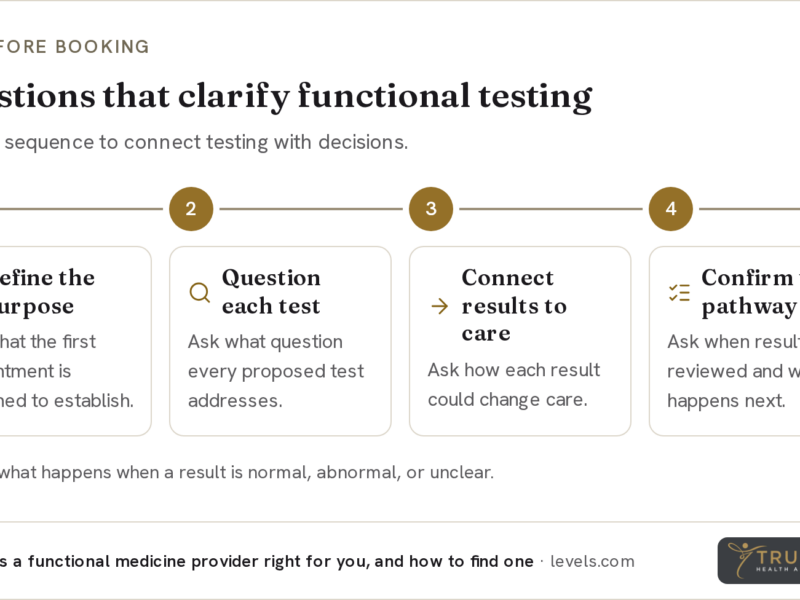 Functional & Holistic Medicine
Functional Medicine Doctor in San Antonio, TX: What to Verify Before Booking
Choose functional medicine care in San Antonio by checking credentials, testing, costs, visit format, and follow-up before booking.
Read article Functional & Holistic Medicine
Women’s Functional Medicine Near Me in Fredericksburg, VA: How to Verify Care Before You Inquire
Compare women's functional medicine near me in Fredericksburg, VA by provider, testing, safety, follow-up, costs, and access.
Read article