

Hormone Therapy & BHRT
How to Find a BHRT Provider Near You: A Practical Shortlist Guide

Use a care-quality shortlist, not a BHRT label
A BHRT provider shortlist should begin with the quality of the evaluation, not with the treatment label on a website. Bioidentical hormone replacement therapy may sound specific, but the label alone does not tell you who will evaluate you, which options will be discussed, how testing will be interpreted, or what follow-up will look like.
Use four filters before you request care:
- Clinical fit: Does the provider evaluate your symptoms, goals, age, time since menopause, medical history, and other relevant conditions before discussing treatment?
- Decision quality: Will the provider explain expected benefits, possible risks, available formulations, and alternatives in language you can understand?
- Continuity: Is there a defined way to reassess your response, revisit the benefit-risk discussion, and adjust the plan when appropriate?
- Practical fit: Do the location, appointment process, access between visits, payment arrangement, laboratory costs, and follow-up costs work for you?
The Menopause Society emphasizes personalization, shared decision-making, and periodic reevaluation of the individual benefit-risk profile. Those points make the label a starting question rather than a reason to choose one practice over another.
A useful shortlist is small enough to compare and specific enough to challenge. For each nearby provider, record who performs the evaluation, what the first visit includes, why each test is ordered, which treatment options are considered, how monitoring works, and what the total anticipated cost may be. Then compare answers rather than promises.
To turn those answers into a usable comparison, keep one record for each practice rather than relying on memory. Begin with the provider’s name, the location or locations offered, the date you checked the information, and the way the practice asks prospective patients to make contact. Record the provider’s own definition of BHRT separately from your notes about the care arrangement. This prevents a familiar term from filling in details the practice has not actually supplied.
Give the record a line for the person who conducts the evaluation and another for the person responsible for prescribing and follow-up. If the answers differ, note that difference and ask who owns each clinical decision. Write down training, board certification, menopause-related credentials, and relevant experience as the provider presents them. A listing or credential can help you form a question, but it does not answer how the evaluation will work.
Use a separate section for the first visit. Note whether the discussion covers symptoms, goals, age, time since menopause, medical history, comorbidities, current medicines, prior treatment, options, risks, alternatives, screening, and monitoring. These are not boxes that prove a provider is suitable. They are prompts for finding out whether the provider connects the discussion to your circumstances. Leave a blank when the practice has not answered rather than guessing what happens during the appointment.
For testing, copy the name of each proposed test and the clinical question the provider says it addresses. Add who will interpret it, when you will receive the result, and what decision could change because of it. If a practice describes testing without explaining its role, keep “purpose not explained” in the record. That wording is more useful than treating a test list as evidence of a thorough evaluation.
For treatment options, record whether the provider discusses FDA-approved menopausal products, compounded preparations, or both. Note the explanation of approval status, potential risks and benefits, alternatives, and any reason given for considering one option. Do not convert a provider’s marketing language into a conclusion about safety, effectiveness, or suitability. The comparison is about the explanation you receive and the questions that remain.
For follow-up, capture when reassessment occurs, which symptoms or concerns should be reported, who reviews changes, how you communicate between visits, and whether repeat testing or screening is discussed when relevant. A general statement about ongoing care is not the same as a defined process, so ask for the missing timing or responsibility instead of filling it in yourself.
Keep practical details in their own section: in-person or virtual visits, testing location, initial appointment process, consultation fee, laboratory charges, medication costs, follow-up charges, insurance or out-of-network terms, and the total anticipated cost of care. Costs can vary, and a general cash-based or insurance statement does not supply a personal estimate. Ask what is included and what is billed separately.
Before you contact a practice, mark each line as answered, partly answered, or unanswered. Answered means the provider gave a specific response to your question; it does not mean the response establishes clinical fit. Partly answered identifies a point that needs clarification. Unanswered preserves uncertainty. This simple distinction helps you compare providers without turning missing information into an assumption.
Finally, write down the questions that matter most to you, such as how the practice handles virtual follow-up, who will explain results, or how costs are disclosed. Personal priorities can guide the order of your questions, but they do not determine whether hormone therapy is appropriate. Keep the record for each practice separate, use the same core questions, and decide only after you understand which points have been addressed and which still require a qualified clinician’s explanation.
Clarify what BHRT means before comparing providers
BHRT means bioidentical hormone replacement therapy, while hormone therapy, hormone replacement therapy, and menopausal hormone therapy are overlapping terms used in menopause care. The Menopause Society and ACOG use broader hormone-therapy language, while True You Health and Wellness uses BHRT to describe an offered service in Spotsylvania, Virginia.
The terminology matters because two providers may use the same label for different clinical arrangements. One may discuss FDA-approved menopausal products. Another may discuss compounded preparations. A third may use BHRT as a general description while deciding later which formulation, route, dose, and duration fit the clinical situation. You need the provider to define the term in practical language.
Ask these questions before comparing treatment menus:
- What does BHRT mean in this practice?
- Which products or formulations do you discuss?
- Are the options FDA-approved, compounded, or both?
- What factors determine the route, dose, duration, and regimen?
- How do you explain the expected benefits, possible risks, and alternatives?
- What would make you recommend against hormone therapy or delay the decision?
A bioidentical label does not establish that a preparation is safer or more effective. ACOG says evidence is lacking for those claims when they are made about compounded bioidentical menopausal hormone preparations. If a compounded option is being considered, ask how the provider will explain its lack of FDA approval and its potential risks and benefits, including risks specific to compounding.
The answer you want is not a slogan. You want a clear explanation of what the provider means by BHRT and how that meaning affects the choices you may discuss.
Start with the symptoms and goals you want to discuss
Your symptoms and goals should shape the first conversation, but symptoms should not be treated as proof of a hormone imbalance. Hot flashes and night sweats can affect daily function and quality of life at home and work, and hormone therapy can help relieve symptoms of menopause and perimenopause. Neither point establishes that hormone therapy is appropriate for your situation.
Prepare a short, factual account instead of arriving with a conclusion about the treatment you need. Include:
- Which symptoms concern you most and when they began.
- How often they occur and how they affect sleep, work, exercise, relationships, or daily activities.
- Where you are in the menopause transition, if that is known.
- Your treatment goals, such as discussing hot flashes, night sweats, genitourinary symptoms, or another concern.
- Current medicines, supplements, and relevant health conditions.
- Previous evaluations, treatments, or side effects that you want the clinician to understand.
- Questions about fertility, contraception, sexual function, or other personal priorities that affect the conversation.
A symptom list gives the clinician something concrete to evaluate. Ask how the provider separates a symptom discussion from a diagnosis and what information would change the assessment.
The Menopause Society says hormone-therapy decisions should be personalized and revisited periodically. The relevant question is therefore not simply whether a provider treats hot flashes or advertises BHRT. Ask how the provider connects your goals with an individualized benefit-risk discussion and how that discussion will be revisited over time.
Bring your notes to each shortlisted provider. Consistent questions make the answers easier to compare.
Verify who performs the evaluation
The clinician who evaluates you should be identifiable before you request hormone care. A practice name, attractive service page, or convenient location does not tell you who will review your history, discuss risks, interpret results, prescribe treatment, or provide follow-up.
Ask each practice to identify:
- The licensed healthcare professional who conducts the initial evaluation.
- The professional’s training, board certification, and experience with menopause care.
- Whether the same clinician will make treatment decisions and follow your progress.
- Who answers clinical questions between visits.
- Which parts of care are handled by the clinician, laboratory, pharmacy, or support staff.
- Whether the provider has a formal menopause credential or other relevant training.
The Menopause Society offers a searchable listing that includes healthcare professionals with the MSCP credential. That listing can give you one way to identify practitioners for further comparison, but a credential should lead to better questions rather than replace them. Ask what the credential or training means in the provider’s day-to-day evaluation and follow-up process.
Clinical characteristics matter in the risk-benefit discussion. The Endocrine Society review identifies age, time since menopause, and comorbidities as factors associated with different hormone-therapy risk-benefit and safety profiles. A provider who asks about those factors is addressing the decision as an individual clinical question rather than treating the BHRT label as a shortcut.
Write the answers down. If a website does not identify who evaluates you, or if staff cannot explain who is responsible for clinical decisions, keep that practice in the question stage and do not assume the arrangement.
Ask what the first evaluation actually includes
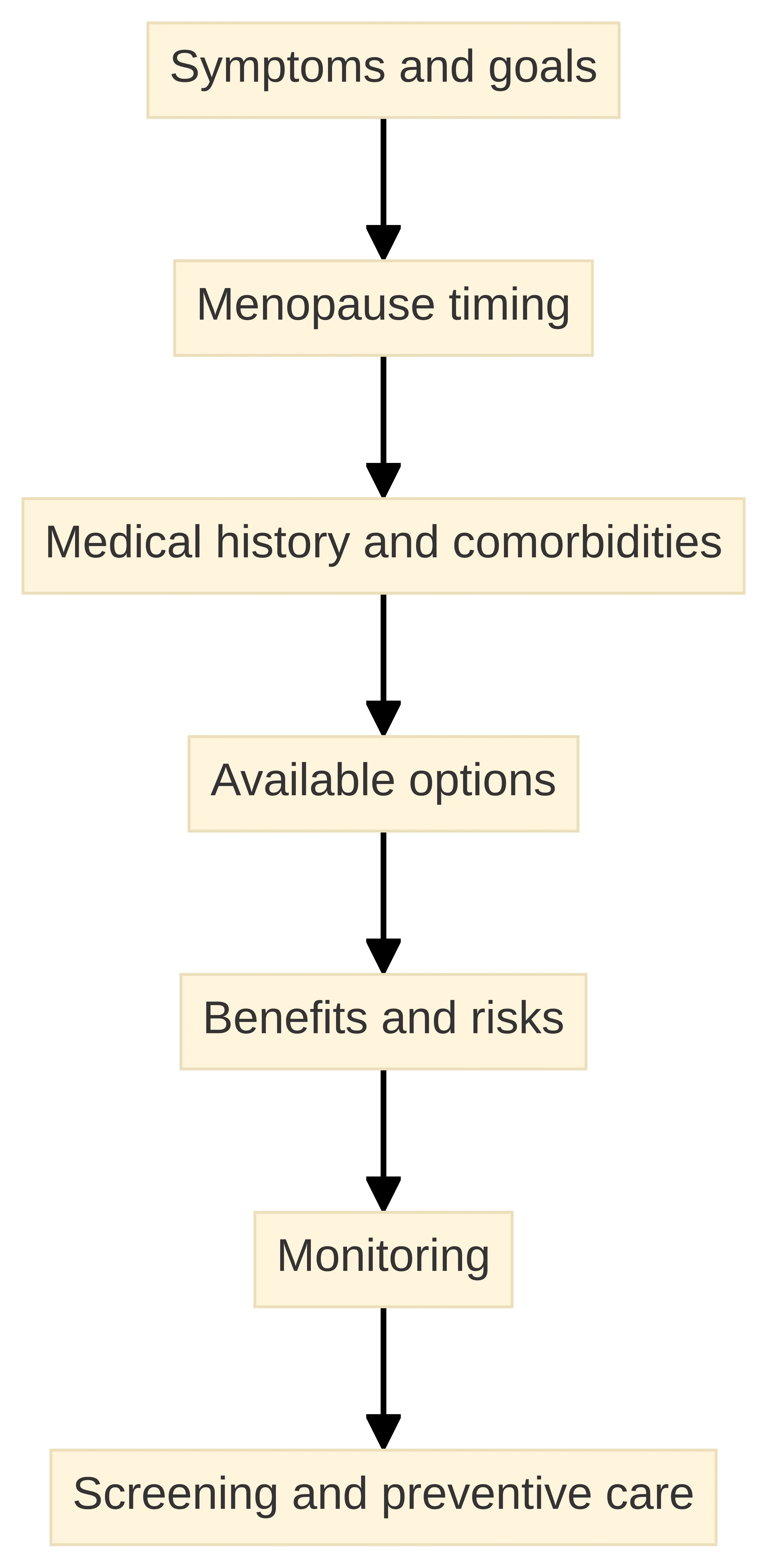
The first BHRT evaluation should give you a reasoned explanation of your symptoms, goals, relevant health factors, available options, and next steps. The appointment does not need to produce a prescription to be useful. It should make clear what the clinician knows, what still needs assessment, and why a proposed plan would fit the information available.
Ask whether the evaluation includes a discussion of:
- Symptoms and goals. Explain what you want help with and how the concerns affect your life.
- Menopause timing. Ask how your age and time since menopause affect the benefit-risk discussion.
- Medical history and comorbidities. Ask which health conditions, medicines, and prior treatments could change the decision.
- Available options. Ask whether FDA-approved and compounded options are considered, and why one would be discussed over another.
- Benefits and risks. Ask what improvement the treatment is intended to address and which risks apply to your circumstances.
- Monitoring. Ask what will be reviewed after treatment begins and what would lead to a change in the plan.
- Screening and preventive care. Ask how relevant screening recommendations fit into the discussion.
The Menopause Society recommends personalization and shared decision-making, including selection of dose, duration, regimen, and route based on symptoms and treatment goals, followed by periodic reevaluation. The Endocrine Society review also explains that hormone-therapy risk-benefit profiles vary with age, time since menopause, and comorbidities.
If you have a uterus and estrogen-progestogen therapy is being considered, ask how the clinician will discuss its risks and benefits, including breast-cancer considerations and recommended screening. The Endocrine Society guideline advises that discussion.
A provider does not need to promise a particular result to demonstrate a useful process. You need an evaluation that connects the clinical questions to the proposed next step.
Require a reason for every test
A hormone test should have a stated purpose in your evaluation. Before agreeing to laboratory work, ask what the test measures, what question it addresses, how the result will be interpreted, and what decision could change because of the result.
Use this testing checklist:
- What clinical question is this test intended to answer?
- Why is the test useful for my symptoms, goals, age, or time since menopause?
- What could the result mean in the context of my history and other health factors?
- Would a high, low, or inconclusive result change the proposed plan?
- Do timing, current medicines, supplements, or recent treatment affect interpretation?
- Who will review the result with me?
- Will I receive the result and an explanation before a treatment decision?
- What follow-up testing, if any, would be considered, and why?
A laboratory number should not carry the whole decision. The Menopause Society’s guidance places hormone-therapy decisions within personalization, shared decision-making, treatment goals, and periodic reevaluation. That framework supports asking how testing fits the clinical conversation rather than treating a panel as a substitute for evaluation.
True You Health and Wellness states that Dr. Hoff explains laboratory results by connecting them to symptoms and recommends parts of each patient’s plan based on those results. True You also states that it provides in-person testing and virtual follow-up. If you compare this practice with another provider, ask each one to explain the same testing questions in comparable detail.
Do not assume that more tests create a better decision. Require a clear connection between each test, the question being asked, and the action that may follow.
Compare FDA-approved and compounded options explicitly
FDA-approved and compounded hormone options deserve a direct comparison rather than a vague promise that one is “natural.” ACOG says evidence is lacking for marketing claims that compounded bioidentical menopausal hormones are safer or more effective than FDA-approved therapies. ACOG also says compounded bioidentical menopausal hormone therapy should not be used routinely when FDA-approved formulations are available.
| Question | FDA-approved menopausal therapy | Compounded bioidentical therapy | What you should ask |
|---|---|---|---|
| How is the option described? | Ask which FDA-approved product or formulation is being considered. | Ask which compounded preparation is being considered and why. | What does this option address, and why does it fit the clinical question? |
| What approval information applies? | Ask what FDA approval means for the proposed product. | ACOG says compounded preparations lack FDA approval. | How will the clinician explain the potential benefits, risks, and limitations? |
| Why choose this option? | Ask which clinical factors support the choice. | Ask why compounding is being considered when an FDA-approved formulation exists. | What alternative was considered, and why was it not selected? |
| How will the plan be followed? | Ask how response, risks, and screening will be reviewed. | Ask the same questions and include risks specific to compounding. | What happens if the response is limited or concerns arise? |
The table is a question framework, not a treatment recommendation. FDA approval does not determine whether a therapy is appropriate for you, and a compounded label does not establish that a preparation is safer or more effective. A qualified clinician must connect the option to your history, goals, and risk factors.
If you request a compounded option, ACOG says the clinician should explain its lack of FDA approval and discuss potential risks and benefits, including risks specific to compounding. Treat an explanation that skips those points as an unanswered question.
Use the same questions with every provider. Consistent comparison helps you distinguish a clinical rationale from a marketing description.
Look for a real follow-up and monitoring plan
A hormone-therapy plan should include a clear way to reassess your response and benefit-risk profile. The Menopause Society recommends periodic reevaluation and says dose, duration, regimen, and route should be selected around symptoms and treatment goals. A first appointment without a defined follow-up conversation leaves an important part of the decision unanswered.
Ask the provider:
- When will you review your response and concerns after treatment begins?
- Which symptoms, goals, side effects, or other changes should you report?
- What would lead to a dose, route, regimen, or duration change?
- Who reviews follow-up information and how do you reach that person?
- Which laboratory tests or clinical assessments are repeated, and what decision does each support?
- How often is the benefit-risk discussion revisited?
- How do breast-cancer screening recommendations or other preventive-care needs fit into follow-up when relevant?
The Endocrine Society guideline advises discussion of risks and benefits for women with a uterus who choose estrogen-progestogen therapy, including breast-cancer considerations and recommended screening. Bring that topic into the conversation instead of treating the prescription as the end of evaluation.
True You Health and Wellness states that it offers direct access to physicians and follow-up that tracks changes in health status. True You also states that the same physician follows patients over time. If those arrangements matter to you, ask how they work for the specific care you are considering and what communication channel applies between visits.
A follow-up plan should be concrete enough for you to understand what happens after the first decision. If the answer is only “we will see how it goes,” ask what will be reviewed, when, and by whom.
Audit practical fit before requesting care
The practical arrangement can determine whether an otherwise promising provider fits your life. Compare location, appointment access, communication, testing logistics, payment expectations, and ongoing costs before you commit to an evaluation.
Ask for clear answers to these questions:
- Where does the evaluation occur, and where is testing performed?
- Are follow-up visits in person, virtual, or available through both arrangements?
- How do you request an initial appointment?
- Who answers questions between visits, and what access does that include?
- What are the consultation, laboratory, medication, and follow-up charges?
- What total anticipated cost should you expect before treatment starts?
- Is the practice cash-based, insurance-based, or out of network?
- If medication is compounded, is it typically covered by insurance, and what payment support may be available?
- Which services are included in the stated fee, and which are billed separately?
Consultation fees, laboratory testing, and follow-up care can differ by provider, so ask for the total anticipated cost of care. The selected pharmacy source says compounded medications are typically not covered by insurance, while coverage and support resources may vary. Ask about the specific medication and arrangement being proposed.
True You Health and Wellness states that it is a cash-based service and discusses costs transparently during consultations. True You also states that it provides in-person testing and virtual follow-up and offers initial appointments for scheduling. Those statements describe the practice’s stated arrangement; use your questions to understand what the arrangement means for your evaluation, testing, and follow-up.
For a busy professional, athlete, military family, or patient traveling between Fredericksburg, Spotsylvania, Stafford, Quantico, King George, Richmond, or Northern Virginia, access details may matter as much as the treatment label. Put every answer in your shortlist before choosing whom to contact.
Use True You Health and Wellness as one option to verify
True You Health and Wellness is one nearby option to place through the same comparison process. We offer bioidentical hormone replacement therapy in Spotsylvania, Virginia, and we offer a customized approach to hormone replacement therapy with treatment plans tailored to individual wellness needs and objectives.
Our stated care arrangements include:
- We provide in-person testing and virtual follow-up.
- We offer direct access to physicians and follow-up that tracks changes in health status.
- We are a cash-based service and discuss costs transparently during consultations.
- We offer initial appointments for scheduling.
- The same physician follows our patients over time.
- Dr. Hoff explains laboratory results, connects them to symptoms, and recommends parts of each patient’s plan based on the results.
These are the practice’s stated services and arrangements. They do not determine whether BHRT is appropriate for you, what formulation would be discussed, or what your total cost would be. Use them as prompts for specific questions:
- Who will perform my evaluation, and what qualifications and menopause-care experience should I consider?
- What does BHRT mean in my case, and which FDA-approved or compounded options might be discussed?
- What does each proposed test measure, and how could its result change the plan?
- What follow-up is included, how will changes be tracked, and who will answer questions?
- What are the consultation, laboratory, medication, and follow-up costs in a cash-based arrangement?
- Which parts of care can occur virtually, and which require an in-person visit?
A nearby practice can be convenient without being the right fit, and a distant practice can be impractical even if its website answers some questions well. Compare True You Health and Wellness with other providers using the same criteria: individualized evaluation, explicit options, testing rationale, monitoring, access, and total anticipated cost.
Treat unanswered safety questions as a reason to pause
An unanswered safety question is a reason to pause before choosing a hormone-therapy provider or option. You should be able to ask how your age, time since menopause, medical history, comorbidities, symptoms, and goals affect the discussion. The Endocrine Society review identifies those clinical characteristics as relevant to hormone-therapy risk-benefit and safety profiles.
Pause and ask for clarification if a provider:
- Treats your symptoms as proof of a hormone imbalance without an individualized evaluation.
- Presents “bioidentical” or “natural” as a guarantee of safety or effectiveness.
- Does not explain whether a proposed option is FDA-approved or compounded.
- Avoids discussing potential risks, alternatives, or the reason for a formulation.
- Orders testing without explaining what each result could change.
- Offers treatment without describing reassessment and monitoring.
- Does not explain relevant screening or follow-up considerations.
- Gives no clear answer about who will manage concerns after treatment begins.
The Endocrine Society guideline advises discussion of risks and benefits, including breast-cancer considerations and recommended screening, for women with a uterus who choose estrogen-progestogen therapy.
If symptoms such as hot flashes, night sweats, or genitourinary symptoms are prompting you to consider BHRT, bring them to a qualified healthcare professional for evaluation rather than treating them as proof of a hormone imbalance or choosing hormones yourself. Do not select a regimen or change hormones based on an advertisement, a symptom list, or a test result alone. Return to the provider with a specific question, seek another evaluation, or keep the decision open until the clinical explanation is clear.
Make the next step a question-based inquiry
A useful BHRT shortlist leaves you with comparable answers, not merely a list of nearby names. Before you decide whom to contact, make sure you can answer these questions for each practice:
- Who performs the evaluation, and what qualifications or menopause-care training do they bring?
- How does the provider define BHRT, and which FDA-approved or compounded options may be discussed?
- How will symptoms, goals, age, time since menopause, medical history, and comorbidities shape the evaluation?
- What does each test measure, and what decision could its result change?
- When will the provider reassess your response, risks, and treatment goals?
- What are the consultation, laboratory, medication, and follow-up costs, and how does payment work?
A qualified healthcare professional must decide whether hormone therapy is suitable for you, and this guide cannot determine your diagnosis, regimen, dose, or eligibility. Periodic reevaluation matters because hormone-therapy decisions are individualized, and total care costs can vary by provider.
Choose the practice that gives you a clear clinical explanation, a defined monitoring process, and practical terms you understand. If a compounded option is discussed, require the risks, benefits, FDA-approval status, and alternatives to be explained before moving forward.
Questions to ask before contacting a BHRT provider
What should I consider when evaluating BHRT providers?
Focus on the quality of the evaluation, including how symptoms and goals are assessed, the clarity of decision-making, continuity of care, and practical fit regarding location and costs.
How does BHRT differ from general hormone therapy?
BHRT specifically refers to bioidentical hormone replacement therapy, while hormone therapy can encompass a broader range of treatments, including both bioidentical and synthetic options.
What symptoms should I discuss with a BHRT provider?
Prepare to discuss specific symptoms like hot flashes or night sweats, their frequency, impact on daily life, and any relevant medical history, but avoid assuming they indicate a hormone imbalance.
What should I ask about the initial evaluation process?
Inquire about who will conduct the evaluation, what it will cover, how your symptoms and medical history will be assessed, and what options will be discussed.
How important is follow-up care in BHRT?
Follow-up is crucial for monitoring your response to treatment, reassessing risks and benefits, and making necessary adjustments to your therapy.
What practical details should I confirm before contacting a BHRT provider?
Verify the provider’s location, appointment process, payment expectations, and whether they offer in-person or virtual consultations.
Hormone therapy
Wondering if your hormones are behind how you feel?
Dr. Brian Hoff sees patients at our boutique, cash-based practice in downtown Fredericksburg, VA — with time to listen and a plan built around you.
More on Hormone Therapy & BHRT
See hormone therapy Hormone Therapy & BHRT
What Functional Health and Wellness Means for Hormone-Related Concerns
Learn what functional health and wellness means for hormone concerns, testing, physician-led care, and ongoing monitoring.
Read article Hormone Therapy & BHRT
Master BHRT: Understand Benefits and Implementation Steps
Discover the benefits and implementation steps of BHRT for hormonal balance and wellness.
Read article Hormone Therapy & BHRT
Hashimoto Disease: What It Means, How It Is Evaluated, and When to Seek Care
Learn what Hashimoto disease means, how thyroid function is evaluated, and which questions to bring to a healthcare professional.
Read article