

Hormone Therapy & BHRT
Bioidentical Hormone Replacement Therapy in Virginia: Questions to Ask Before You Begin

Start with the tradeoffs behind the BHRT label
The central BHRT decision is how the proposed preparation’s approval status, evidence, formulation, route, and safety boundaries relate to the symptoms and goals under discussion. The word “bioidentical” does not resolve those tradeoffs by itself. A label cannot tell you whether a product is FDA-approved, whether a compounded preparation is being considered, or whether hormone therapy fits your medical circumstances.
Hormone-therapy decisions should use shared decision-making and periodic reevaluation. The discussion should cover the formulation, route, dose, duration, regimen, symptoms, treatment goals, age, circumstances, and potential risk factors. That framework applies whether you live in Fredericksburg, Spotsylvania, Stafford, Richmond, Northern Virginia, or another Virginia community. Your location may shape access and practical arrangements, but it does not turn a symptom pattern into a diagnosis or remove the need for a clinical safety discussion.
Use this guide to prepare for a conversation rather than to choose a product. Before contacting a Virginia practice, write down what you are experiencing, how long it has been happening, how it affects daily life, and which questions you want answered. Bring the discussion back to three points: what explanation is being evaluated, what options are available, and how you will know whether the plan remains appropriate.
Read the BHRT label against approval and evidence
The term “bioidentical” describes a feature used in discussions of some hormone preparations, but it does not identify one single treatment pathway. ACOG notes that “bioidentical hormone” is also used as a marketing term and that FDA-approved menopausal medications may use bioidentical hormones, synthetic hormones, or both. That distinction matters because the label alone does not establish approval status, evidence of safety or effectiveness, route of administration, dose, or monitoring plan.
Hormone therapy is the broader treatment category. BHRT may be used as shorthand for a hormone-therapy approach that emphasizes bioidentical hormones, while compounded bioidentical hormone therapy refers to preparations made through compounding rather than an FDA-approved commercial formulation. Those terms should not be treated as interchangeable. Ask exactly which formulation is being discussed, who makes it, whether it is FDA-approved, and what evidence supports its use for your symptoms.
A natural-sounding description does not settle a safety or effectiveness question. ACOG states that evidence supporting marketing claims that compounded bioidentical preparations are safer or more effective than FDA-approved menopausal therapies is lacking. The practical question is therefore not whether the word sounds reassuring. The practical question is what the proposed preparation is, why it is being considered, what its known and uncertain risks are, and whether an FDA-approved option exists for the clinical purpose being discussed.
Ask a provider to clarify the terminology in plain language:
- Is the proposed option FDA-approved or compounded?
- Which hormone or hormones does it contain?
- What symptom or treatment goal is it intended to address?
- What evidence supports this option for that purpose?
- What approved alternatives could be considered?
- What would make you change or stop the plan?
Clear answers help you compare treatment choices instead of comparing labels.
For a practical comparison, write the provider’s answers in the same order for every option being discussed. Start with the intended symptom or goal, then record the exact preparation, its FDA-approval status, the hormone or hormones involved, and the proposed route. Add the reason the option is being considered, the evidence that applies to that purpose, and the approved or non-compounded alternatives that were reviewed. Then record the safety questions that matter to your circumstances, how effectiveness and tolerability will be assessed, when the plan will be revisited, and what costs are included.
This format helps separate two questions that are easy to blend together: “What is this product?” and “Why does this option fit the clinical discussion?” It also makes uncertainty visible. If a provider cannot explain an option’s approval status, purpose, evidence, alternatives, or follow-up, mark that point as unresolved rather than filling the gap with the word “natural” or “bioidentical.” A written comparison does not tell you which option to choose. It gives you a consistent way to ask whether the reasoning, safety boundaries, and review plan are clear enough for an informed conversation.
Treat symptoms as a reason to investigate, not a diagnosis
Symptoms that prompt a BHRT conversation can include hot flashes, night sweats, disrupted sleep, mood changes, low libido, brain fog, and weight that feels difficult to change. True You Health and Wellness offers BHRT for women experiencing symptoms such as these. Those symptoms can justify a clinical discussion, but they do not prove that a hormone disorder or menopause is the cause.
Menopause-like symptoms can have other causes. NICE notes that mood changes and other symptoms associated with menopause may also occur with different conditions, and its assessment guidance calls for attention to symptom timing, severity, lifestyle factors, and medical history relevant to treatment safety. Fatigue, poor sleep, low mood, or changes in weight therefore deserve a broader conversation when the pattern does not fit neatly or when symptoms persist.
A symptom log can make that conversation more concrete. Record:
- The symptom and when it began.
- How often it occurs and how long each episode lasts.
- What seems to worsen or relieve it.
- Its effect on sleep, work, exercise, relationships, or daily tasks.
- Menstrual changes or bleeding patterns when relevant.
- Current medicines, supplements, lifestyle factors, and major health history.
The log is a discussion aid, not a diagnostic test. It gives you and the clinician a clearer starting point.
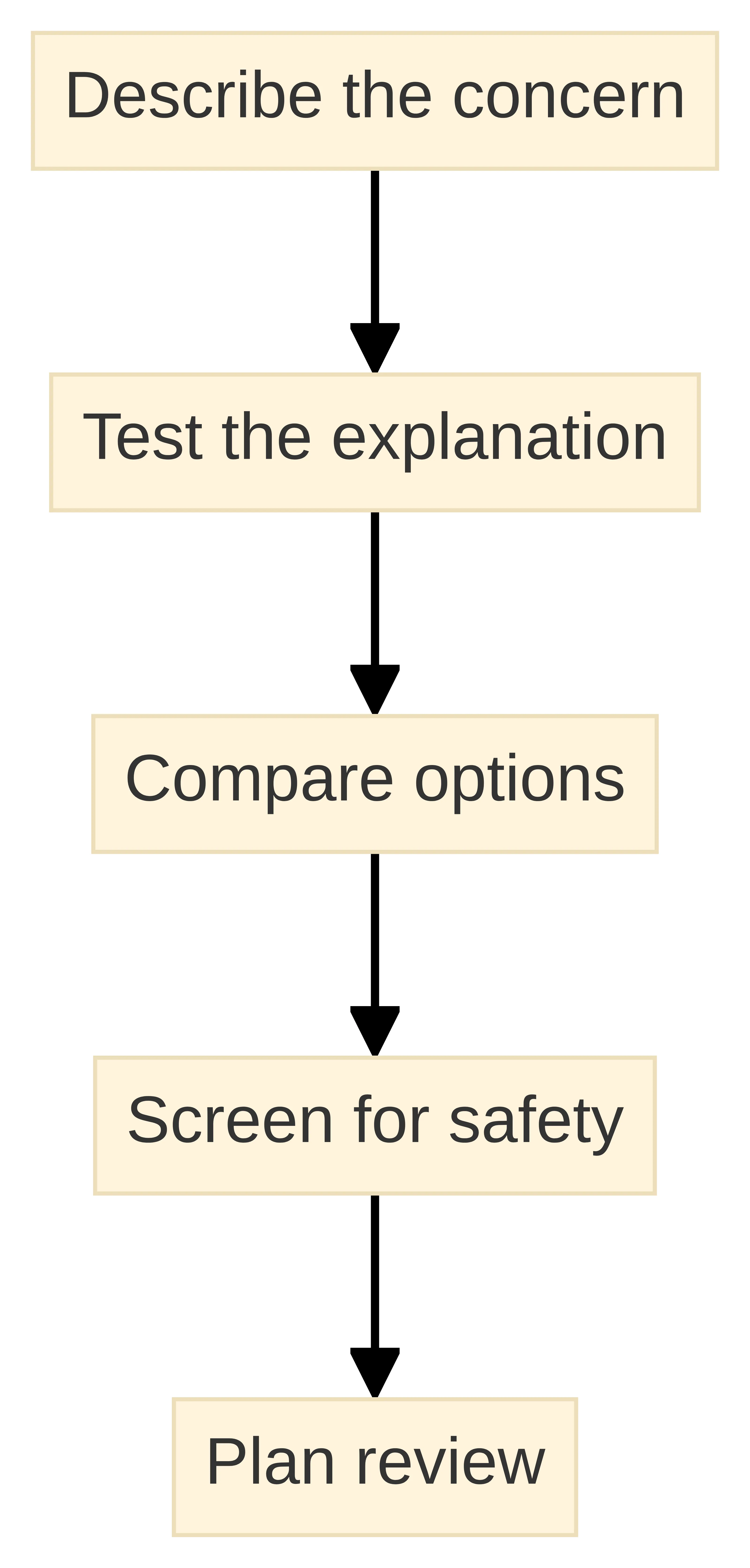
Map the BHRT tradeoffs before the treatment choice
BHRT can be interpreted as a set of linked tradeoffs rather than a label-based choice. The relevant comparison connects the symptoms and goals under discussion with possible explanations, weighs FDA-approved and compounded options, considers formulation and route alongside safety factors, and asks how benefit, tolerability, and continuation will be reviewed. The result is not a product verdict; it is a clearer account of what the evidence and safety boundaries do and do not support.
Use this treatment-choice map when you prepare:
- Name the goal. Bring a specific account of symptoms, timing, severity, and effect on your life.
- Check the explanation. Consider what else could cause the symptoms and what history, examination, or testing is relevant.
- Compare the preparation. Ask whether the option is FDA-approved or compounded, which formulation and route are proposed, and why.
- Set the safety boundaries. Discuss medical history, risk factors, possible contraindications, and route-specific concerns.
- Define the review point. Ask how effectiveness and tolerability will be assessed and what could change the treatment discussion.
Use evaluation to define the treatment boundary
Symptom history supplies context for a BHRT comparison, but it does not establish a hormone-related cause. NICE recommends reviewing the nature, frequency, duration, timing, severity, and effect on quality of life. The discussion should also cover lifestyle factors such as smoking, alcohol, physical activity, and nutrition, along with medical history that could affect treatment safety.
Relevant health history can include cardiovascular disease, high blood pressure, diabetes, venous thromboembolism, and cerebrovascular disease. Menstrual history, pregnancy-related questions, or heavy bleeding may also matter depending on your situation. Tell the clinician about medicines, supplements, previous hormone use, surgeries, and relevant family history when they apply, so the discussion reflects your circumstances rather than a generic symptom list.
Testing should answer a clinical question. True You Health and Wellness states that hormone therapy for perimenopause may be discussed when laboratory results and symptoms support it. Ask what each proposed test is intended to clarify, how the result would affect the decision, and what the clinician would do if the result did not support hormone therapy. That question keeps testing connected to your symptoms and goals rather than treating a panel as an answer by itself.
You can organize the evaluation around a simple interpretation loop. First, describe the concern in terms of timing, severity, and effect on daily life. Second, ask what possible explanations the clinician is considering, including explanations that are not hormone-related. Third, ask which part of the history, examination, or testing bears on those possibilities. Fourth, ask how each possible result would change the options being discussed. Finally, ask what happens if the result is inconclusive, does not support hormone therapy, or does not explain the symptoms.
This loop gives every test a place in the decision rather than allowing the test result to become the whole decision. It also helps you distinguish an evaluation from a product-selection exercise. A result may lead to more discussion, another assessment, an alternative approach, or no change in the proposed plan; the clinician should explain that connection in the context of your symptoms and history. Before the visit, list any previous evaluations or treatments that are relevant and note what questions remain unanswered. During the visit, ask the clinician to explain results in relation to your stated goal instead of assuming that a single number proves a cause, rules out every other cause, or establishes that a particular preparation will help.
An examination or additional assessment may also be relevant to the concern you bring. Ask what the clinician needs to assess in person, what can be handled through discussion, and whether any symptom requires evaluation outside a routine hormone-therapy consultation. A careful process does not assume that every symptom has one cause, and it does not promise that hormone therapy will address symptoms whose cause remains uncertain.
Place potential benefits beside their boundaries
For menopause symptoms, the Menopause Society says hormone therapy is the most effective treatment for vasomotor symptoms and genitourinary syndrome of menopause and has been shown to prevent bone loss and fracture. Those statements describe hormone therapy in the context of menopause care; they do not establish that every product marketed as BHRT has the same evidence, or that hormone therapy is suitable for you.
A benefit discussion should be tied to a defined goal. Ask whether the goal is relief of hot flashes, night sweats, genitourinary symptoms, sleep disruption associated with symptoms, or another concern. Then ask how improvement will be recognized and when the balance of benefit and risk will be revisited. The Menopause Society and ACOG both frame continuation as a decision that depends on symptoms, risks, and benefits rather than on a permanent commitment.
The main limitation is uncertainty about the explanation and the preparation. Symptoms may have causes other than menopause, and ACOG states that evidence supporting claims that compounded bioidentical preparations are safer or more effective is lacking. A product may therefore be discussed in a setting where the symptom cause, the expected benefit, or the comparative evidence still needs to be clarified.
Use four questions to keep the benefit discussion grounded:
- Which symptom or clinical goal is the proposed therapy meant to address?
- What evidence applies to that goal and to the proposed formulation?
- What alternatives could address the same concern?
- What result, side effect, or new information would change the plan?
A qualified clinician can use your answers, medical history, and risk factors to make the discussion specific without turning a general benefit statement into a personal recommendation.
Compare approval status, compounding, and evidence
The approval-versus-compounding tradeoff should be explicit whenever a compounded bioidentical preparation is proposed. ACOG recommends FDA-approved menopausal hormone therapies over compounded bioidentical menopausal hormone therapy for managing menopausal symptoms and says compounded therapy should not be prescribed routinely when FDA-approved formulations exist. If you request a compounded option, ACOG says you should be educated about its lack of FDA approval and potential risks and benefits, including risks specific to compounding.
| Question to compare | FDA-approved menopausal therapy | Compounded bioidentical therapy |
|---|---|---|
| Approval status | FDA-approved formulation | Not FDA-approved, according to ACOG |
| Place in the discussion | Recommended over compounded therapy for menopausal symptoms | Not routinely prescribed when an FDA-approved option exists |
| Evidence conversation | Discuss evidence for the approved option and its intended use | Discuss the lack of supporting evidence for marketing claims of greater safety or effectiveness |
| Risk conversation | Review risks and benefits for your circumstances | Include potential risks and benefits specific to compounding |
| Decision boundary | Ask why this option fits your symptoms and goals | Ask what specific reason makes compounding necessary and what approved alternatives were considered |
The comparison does not mean that a label alone settles every clinical decision. It means the approval status and evidence position should be visible before you consent to a preparation. Ask the provider to explain whether an FDA-approved formulation exists for the purpose under discussion, why it is or is not being considered, and how the proposed alternative changes the uncertainty or risk conversation.
A useful question is: “If an FDA-approved option exists, what clinical reason would support considering a compounded preparation instead, and what are the additional uncertainties?” If the answer relies mainly on the word “natural,” ask for the formulation, evidence, approval status, and monitoring plan in concrete terms. Do not treat a marketing description as a substitute for that explanation.
Ask why the formulation and route fit the discussion
Formulation and route are clinical choices, not details to fill in after the decision. NICE recommends discussing combined versus oestrogen-only therapy, transdermal versus oral therapy, types of oestrogen and progestogen, sequential versus continuous combined therapy, dose, and duration. The relevant option depends on your age, circumstances, symptoms, and potential risk factors.
The route can affect the risk discussion. An ACOG review states that orally administered estrogen may exert a prothrombotic effect, while transdermally administered estrogen has little or no effect on prothrombotic substances in the cited review. That finding does not tell you which route is appropriate for you. It tells you to ask how the route changes the benefits, risks, and alternatives being considered.
Take these questions to the consultation:
- Why is this formulation being considered for my stated goal?
- Why is this route being considered rather than another route?
- Does the plan involve estrogen alone, combined therapy, or another arrangement, and why?
- How do my history and risk factors affect that choice?
- What alternatives have been considered?
- What changes would prompt a different route, preparation, dose, or duration?
The purpose is not to choose a route from a list. The purpose is to understand the reasoning that connects the route to your circumstances.
Set safety boundaries around the comparison
Safety concerns set boundaries for the comparison before a preferred product is considered. The Menopause Society says hormone therapy is generally not a good choice for women with breast cancer, uterine cancer, unexplained uterine bleeding, liver disease, a history of blood clots, or cardiovascular disease. NICE also identifies cardiovascular, blood-pressure, diabetes, clotting, and cerebrovascular history as relevant to treatment safety. These conditions do not become a self-screening checklist for you; they are subjects to raise with a healthcare professional.
These histories do not answer the treatment question on their own. They change which options can be discussed, what additional evaluation may be needed, and how a clinician weighs potential benefits and risks. Raise them before focusing on a preferred preparation; the supplied guidance does not establish individual candidacy.
The evidence provided for this guide does not define an emergency symptom list or an emergency threshold. For that reason, this article should not label a particular symptom as safe to monitor at home or as urgent based on a product comparison. If a concern feels urgent or cannot safely wait for a routine consultation, seek urgent medical care rather than continuing routine hormone-therapy research. If you are unsure which level of care fits a new or worsening concern, ask a qualified healthcare professional or appropriate local care service for confirmation. This distinction protects the purpose of the article: routine research can help prepare questions, but it should not delay evaluation of a concern that needs faster attention.
Unexplained uterine bleeding deserves particular attention before routine hormone-therapy planning. Tell the clinician about bleeding that is new, unusual, heavy, or otherwise unexplained, along with menstrual changes and pregnancy-related considerations when relevant. Do not assume that bleeding is simply another menopause symptom because it occurs alongside hot flashes or sleep disruption.
Clotting history and route should be discussed together. The cited ACOG review notes that venous thromboembolism risk is relevant to estrogen therapy and distinguishes oral from transdermal administration in its discussion. Tell the clinician about any history of blood clots, immobilization, fracture, cardiovascular disease, or other risk factors that you know about, then ask how those details affect the options under consideration.
Before discussing treatment, ask:
- Which parts of my medical and family history change the safety discussion?
- Do my symptoms or bleeding pattern need another evaluation first?
- How do my cardiovascular, clotting, liver, cancer, or blood-pressure risks affect the options?
- Which symptoms or bleeding changes should I tell a clinician about before routine hormone-therapy planning?
- What nonhormonal alternatives should be considered if hormone therapy is not appropriate?
True You Health and Wellness states that when hormone therapy is not appropriate, it discusses alternatives to address symptoms. The decision still belongs in a clinician-led evaluation of your circumstances. For practical planning, keep the levels separate: stable symptoms and questions can support routine consultation; unexplained bleeding or the listed medical histories warrant prompt clinician contact before routine treatment planning; a concern that feels urgent or cannot safely wait calls for urgent medical care. The available guidance does not identify an emergency symptom list, so when the level is unclear, ask a qualified healthcare professional or appropriate local care service rather than relying on this article.
Make follow-up part of the comparison
Follow-up is part of interpreting a proposed option, not a conclusion reached after the choice. The Menopause Society recommends periodic reevaluation of the benefit-risk profile, with the dose, duration, regimen, and route connected to symptoms and treatment goals.
ACOG patient guidance says you and your ob-gyn should discuss each year whether to continue hormone therapy, considering symptoms, risks, and benefits. Annual discussion does not replace earlier contact when a new concern appears. Ask what follow-up timing is planned, what information you should track, and what would lead to an earlier review.
Make the review specific enough that you can participate in it. Before follow-up, bring the original goal back into view: which symptom or concern was the proposed plan meant to address, and how has it changed? Also note whether the change was meaningful in daily life, whether any unwanted effects appeared, whether a new medical concern affects the risk discussion, and whether the plan remains acceptable to you. These observations do not replace clinical assessment, but they give the clinician concrete information to interpret.
At the review, ask four separate questions rather than treating “How is it going?” as the whole assessment: What benefit is evident for the stated goal? How well is the preparation tolerated? Have new symptoms, diagnoses, medicines, or risk factors changed the discussion? What are the reasons to continue, adjust, stop, or consider an alternative? The answers should connect to the formulation, route, dose, duration, and monitoring plan being discussed. If retesting is proposed, ask what question it is meant to answer and how the result could affect the next step. A follow-up plan is more useful when it explains not only when you will be reviewed, but also what information will be reviewed and which decisions could follow.
At True You Health and Wellness, hormone-therapy follow-ups may include tracking how you feel, retesting when needed, and adjusting treatment. That describes the practice’s stated follow-up process; it does not predict what your own plan would involve. Ask whether follow-up for you would be virtual, in person, or both, and how the practice would handle a symptom change or a result that alters the treatment discussion.
Before proceeding, make sure you understand:
- When the first review would occur.
- Which symptoms or goals will be assessed.
- Whether tolerability and side effects will be reviewed.
- When retesting would be considered and what question it would answer.
- Who to contact if your situation changes.
- How continuation, adjustment, or stopping would be discussed.
A plan with no clear review point leaves an important clinical decision undefined.
Compare practical tradeoffs and plan monitoring
Begin with the reasoning for treatment, not with a product name. Questions for a Virginia provider include:
- What symptoms or goals are we addressing, and what other explanations should be considered?
- What parts of my history, examination, or testing matter to that discussion?
- What would a proposed test clarify?
- How would a result change the treatment options?
- What findings would make hormone therapy less appropriate to discuss?
- Which symptoms or changes should I record before follow-up?
The answers should show how the clinical information connects to the treatment choice. Symptoms alone do not establish a hormone-related cause, so the explanation matters as much as the proposed option.
Then compare the preparation and route. Ask:
- Is the proposed product FDA-approved or compounded?
- If compounded, why is it being considered when an FDA-approved formulation exists?
- What formulation and route are being discussed, and why?
- What evidence supports this option for the symptoms or goal?
- What limitations, risks, and uncertainties should I weigh?
- How does the route affect the discussion of clotting risk?
- What alternatives should be considered?
ACOG says evidence for marketing claims that compounded bioidentical preparations are safer or more effective is lacking, and recommends FDA-approved menopausal hormone therapies over compounded therapy when approved formulations exist. The comparison should therefore focus on the evidence and the clinical fit, not on the word “bioidentical” alone.
Make monitoring part of the initial discussion:
- How will effectiveness and tolerability be assessed?
- When will we revisit symptoms, risks, and benefits?
- What changes should I report before that review?
- When would retesting be considered?
- What could lead to a change in dose, preparation, route, or duration?
- What would prompt a discussion about stopping or using another approach?
A defined reassessment point ties continuation to current symptoms, risks, benefits, and goals. It also makes clear that continuation is a decision to revisit rather than an automatic next step.
Financial terms belong in the treatment discussion because they affect whether the proposed follow-up is workable. Ask:
- What will the consultation, testing, medication, and follow-up each cost?
- What is included in each stated cost, and what is separate?
- Does the practice bill insurance, or would I pay directly?
- What follow-up arrangements apply to the proposed care?
- How are costs handled if testing or treatment changes?
True You Health and Wellness is cash-based, with transparent costs and comprehensive testing. Those are this practice’s stated terms; ask any Virginia provider for the costs and follow-up arrangements that apply to the option under discussion.
Connect the evaluation to the treatment plan
The treatment discussion should show how the proposed therapy becomes a clinical plan. At True You Health and Wellness, our in-person functional-medicine visit covers your symptoms, history, nutrition, sleep, stress, and goals. Ask how those details inform the proposed formulation, route, safety review, and follow-up; this describes the practice’s stated process, not a conclusion about whether BHRT is appropriate for you.
We offer BHRT for women experiencing perimenopause and menopause symptoms such as hot flashes, night sweats, disrupted sleep, mood swings, low libido, brain fog, and stubborn weight. We may discuss hormone therapy for perimenopause when your laboratory results and symptoms support it. Those are the conditions under which we describe the service; they are not a promise that hormone therapy will be appropriate for you or that a symptom has a hormonal cause.
If hormone therapy is not appropriate, we discuss alternatives to address your symptoms. Ask how that decision is made, what information supports it, and how the practice handles symptoms that may have another cause. A practice should be able to explain both the reason for discussing hormone therapy and the boundary that would lead to another approach.
We are cash-based, with transparent costs and comprehensive testing. That means you should include payment structure in your practical questions rather than treating it as separate from care. Ask what the initial evaluation covers, how testing is handled, what follow-up includes, and how costs change if the plan is adjusted. Financial clarity helps you decide whether the proposed process is workable before you commit to it.
Know what this guide cannot decide
This guide cannot decide whether hormone therapy is appropriate for you, identify the cause of your symptoms, select a formulation or route, determine a dose or duration, or weigh your personal risks and benefits. Symptoms alone do not establish menopause as the cause, and a general statement about hormone therapy does not establish that a particular preparation fits your circumstances.
The evidence also cannot turn the word “bioidentical” into a safety guarantee. ACOG says evidence supporting claims that compounded bioidentical preparations are safer or more effective is lacking, while the Menopause Society emphasizes shared decision-making and periodic reevaluation for hormone therapy. Use that uncertainty as a reason to ask better questions about approval, alternatives, route, monitoring, and follow-up.
When symptoms are stable and the main need is to compare options, routine research can help you prepare for a standard clinician conversation. Prompt clinician review is appropriate before routine hormone-therapy planning when there is unexplained uterine bleeding, a history of breast or uterine cancer, liver disease, blood clots, or cardiovascular disease. If a concern feels urgent or cannot safely wait for a routine appointment, seek urgent medical care rather than relying on this guide; this article does not define an emergency threshold. These concerns should be raised with a qualified healthcare professional, not resolved from a product label or a general symptom list. These concerns can affect whether hormone therapy is considered and how risks are weighed. Raise them with a qualified healthcare professional before treating them as part of a routine product comparison.
Choose the next conversation, not a product
The useful BHRT decision is a question of clinical reasoning, not label appeal. Bring a symptom record, relevant history, and a written list of questions about the explanation, approval status, formulation, route, alternatives, safety, costs, and follow-up. A productive conversation should leave you understanding what is being considered, why it is being considered, what remains uncertain, and when the decision will be reviewed.
If you are considering a Virginia consultation, use those questions to discuss whether your symptoms and goals support further evaluation. True You Health and Wellness offers BHRT for women with perimenopause and menopause symptoms and may discuss hormone therapy for perimenopause when laboratory results and symptoms support it. The next useful step is a specific conversation about your circumstances, not a decision based on the word “bioidentical” alone.
Questions to ask before requesting hormone-therapy help
What symptoms may prompt someone to consider hormone therapy?
Symptoms that may lead to a discussion about hormone therapy include hot flashes, night sweats, disrupted sleep, mood changes, low libido, brain fog, and difficulty with weight management. However, these symptoms do not confirm a hormone disorder.
What should I ask a healthcare provider about hormone therapy options?
You should ask about the specific formulation being proposed, whether it is FDA-approved or compounded, what symptoms it aims to address, the evidence supporting its use, and what alternatives are available.
How does the route of administration affect hormone therapy?
The route of administration, whether oral or transdermal, can influence the risks and benefits of hormone therapy. For example, orally administered estrogen may have different effects on clotting risk compared to transdermal options.
What safety considerations should be discussed before starting hormone therapy?
Safety considerations include discussing any history of breast cancer, uterine cancer, unexplained uterine bleeding, liver disease, blood clots, or cardiovascular disease, as these conditions may affect the appropriateness of hormone therapy.
How often should I have follow-up discussions about hormone therapy?
It is recommended to have annual discussions with your healthcare provider about the continuation of hormone therapy, considering your symptoms, risks, and benefits. Regular reviews help ensure the treatment remains appropriate.
What costs should I expect for hormone therapy consultations in Virginia?
Costs for hormone therapy consultations can vary. It is important to ask about the fees for the initial consultation, any testing, medications, and follow-up visits, as well as whether the practice operates on a cash basis or accepts insurance.
Hormone therapy
Wondering if your hormones are behind how you feel?
Dr. Brian Hoff sees patients at our boutique, cash-based practice in downtown Fredericksburg, VA — with time to listen and a plan built around you.
More on Hormone Therapy & BHRT
See hormone therapy Hormone Therapy & BHRT
BHRT Near Falmouth, VA: What to Verify Before Contacting a Clinic
Searching near Falmouth? Learn how to verify a BHRT clinic’s location, evaluation, follow-up, costs, and insurance before you inquire.
Read article Hormone Therapy & BHRT
Menopause Treatment Options: A Symptom-First Decision Guide
Compare menopause care options by symptom and prepare focused questions for a clinician near Spotsylvania Courthouse.
Read article Hormone Therapy & BHRT
What Functional Health and Wellness Means for Hormone-Related Concerns
Learn what functional health and wellness means for hormone concerns, testing, physician-led care, and ongoing monitoring.
Read article