

Hormone Therapy & BHRT
What Functional Health and Wellness Means for Hormone-Related Concerns

Start with the decision behind the label
Functional health and wellness is best understood as a way to organize a healthcare conversation, not as a diagnosis or a promise that every symptom has one discoverable cause. The practical question is whether a clinician will look at your concern in context, explain what the available information can and cannot show, and build the next step around an individualized discussion.
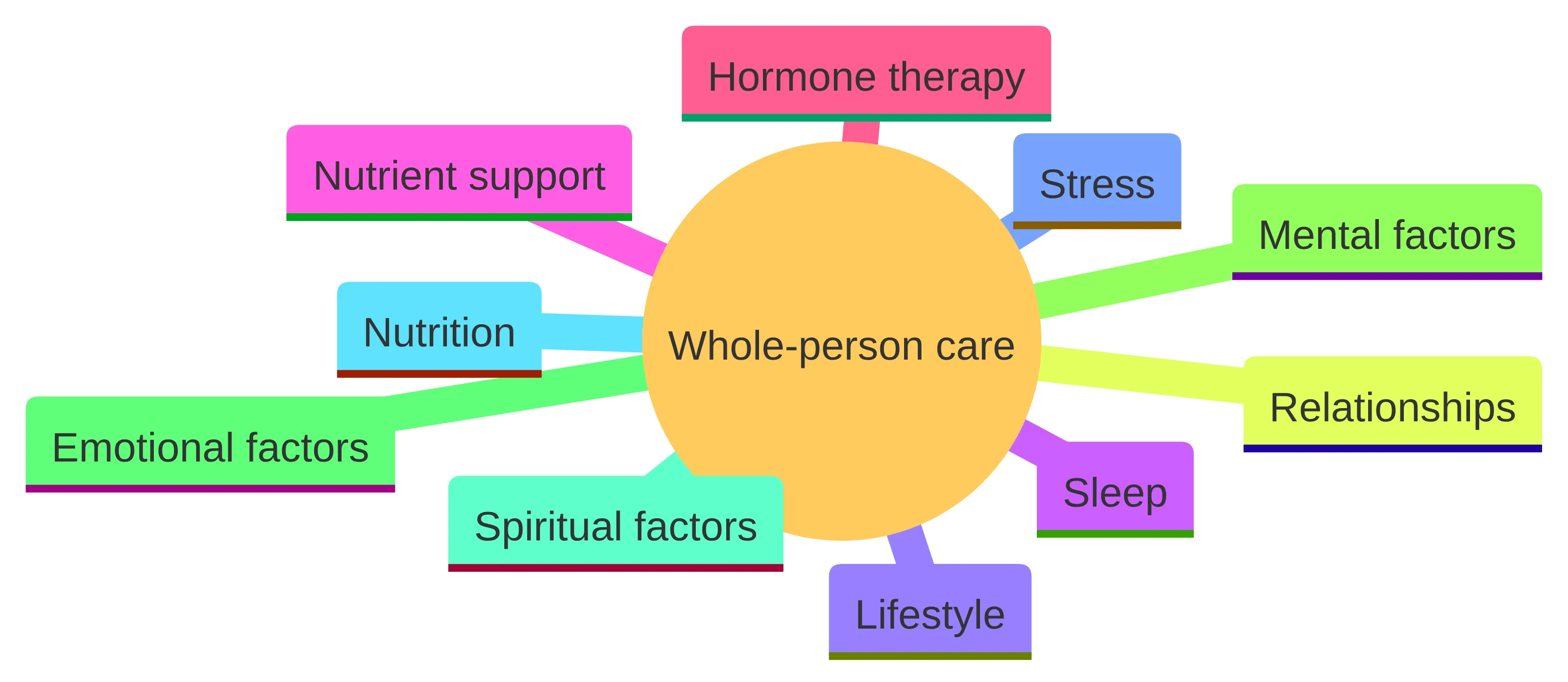
A whole-person approach can look beyond diet and exercise to sleep, stress, relationships, and mental, emotional, and spiritual factors. A root-cause-oriented approach aims to make care more personal by considering contributing factors rather than treating every symptom as an isolated event. Those ideas can guide useful questions, but they do not establish a diagnosis by themselves.
Your decision is not whether to accept a label. For menopause-related hormone therapy, the Menopause Society recommends shared decision-making and periodic reevaluation of the benefit-risk profile.
For hormone-related concerns, look for four connected parts:
- A conversation about symptoms, goals, health history, and factors that may affect the concern.
- Testing that has a stated purpose rather than functioning as a shopping list.
- A clear explanation of whether hormone therapy is being considered, and why.
- A monitoring plan that allows the clinician and you to reassess the decision over time.
Use those four parts as your decision lens. A practice that cannot explain them clearly deserves more questions before you proceed.
Functional health and wellness in practical terms
Functional care starts with the concern you want to understand and asks what information may help put it in context. The approach may consider contributing factors alongside symptoms, rather than assuming that managing one symptom answers the larger question. For perimenopause, the Institute for Functional Medicine describes an approach that may address issues associated with hormone imbalance and may include lifestyle or nutraceutical care, hormone therapy, or both.
That description leaves room for clinical judgment. It does not mean that every symptom comes from hormones, that every test will reveal a cause, or that hormone therapy belongs in every plan. It means the conversation can remain broad enough to examine the concern before narrowing the next step.
Whole-person care gives the word “wellness” a practical boundary. Sleep, stress, relationships, and mental, emotional, or spiritual factors may be relevant parts of the conversation, while nutrition and lifestyle may also appear in a plan. True You Health and Wellness describes plans that may include changes to sleep and stress, nutrition, nutrient support, and hormone therapy when appropriate.
The useful question is not whether every part of your life will be treated. Ask which factors are relevant to your concern, how the practice will assess them, and which proposed changes are connected to the clinical question. That keeps a broad approach from becoming a collection of general suggestions with no clear purpose.
Root-cause language also needs a boundary. A contributing factor is not automatically the cause of your symptoms, and a possible association is not the same as a confirmed explanation. You should expect a clinician to distinguish between what your history suggests, what testing supports, and what remains uncertain.
A useful explanation sounds specific: the clinician identifies the question being considered, tells you what information bears on that question, and explains what would change the plan. A vague explanation that assigns every concern to one broad cause gives you less information for making a healthcare decision.
What a useful evaluation brings together
A useful hormone-related evaluation brings together your symptoms, goals, health history, and relevant test results instead of treating any single item as the whole picture. The American Academy of Procedural Medicine advises asking how a practice uses your history and test results; it identifies a one-size-fits-all plan that disregards those details as a warning sign.
Your evaluation conversation may therefore include questions such as:
- Which symptoms or changes prompted you to seek help?
- What outcome would make the conversation useful to you?
- What health history could affect the interpretation of your concerns?
- How will current medicines, supplements, and previous care be considered?
- Which sleep, stress, nutrition, or lifestyle factors are relevant to the question?
- What information is already available, and what additional information would change the next step?
These questions do not diagnose hormone imbalance. They help you see whether the practice is building a context-specific discussion.
Symptoms can start the conversation without settling its conclusion. Perimenopause care, for example, may address contributing issues while considering lifestyle or nutraceutical care, hormone therapy, or a combination. The possible range of approaches is not a recommendation for your situation.
Sleep and stress deserve the same careful treatment. Whole-person care can include them, but mentioning them does not prove that either factor explains your symptoms. Ask what role the factor has in the evaluation and how the clinician will decide whether it belongs in your plan.
Health history and test results should remain connected to the question being asked. Ask how a proposed test or recommendation relates to your concern, what decision it may inform, and what happens if the result does not support the initial possibility.
A practice should also be able to explain how it works alongside conventional medicine. The American Academy of Procedural Medicine identifies coordination with conventional medicine, rather than advice to reject it, as a quality consideration. You can ask how information from other clinicians will fit into the discussion before you choose a care pathway.
Testing should answer a clinical question
Testing should answer a clinical question rather than create the appearance of a complete explanation. True You Health and Wellness describes its functional medicine work as using advanced testing and evidence-based treatments alongside nutrition and lifestyle. That description tells you the practice uses testing as part of its model; it does not tell you which tests belong in your situation.
Before testing, ask:
- What question is this test intended to answer?
- How could the result change the plan?
- What will happen if the result is normal, unclear, or inconsistent with your symptoms?
- How will the result be interpreted with your history and other information?
A clear answer helps you understand the role of testing without treating a test result as a diagnosis.
Laboratory interpretation should connect the result to your concern. At True You Health and Wellness, Dr. Hoff explains laboratory results to patients. The practical standard is an explanation you can follow: what the result measures, why it matters to the question, and what action—if any—it supports.
Testing also has limits. A result cannot replace a clinical conversation, and a broad panel cannot by itself establish that hormone therapy is appropriate. Keep asking what the information changes.
A one-size-fits-all testing pathway is a reason to pause and ask more questions. The American Academy of Procedural Medicine describes an individualized approach as one that uses your history and test results rather than giving every person the same protocol.
You can ask whether the practice adjusts its evaluation when your history, symptoms, or results differ from someone else’s. A direct answer should make the reasoning easier to understand, not pressure you to accept a predetermined package.
Where hormone therapy may fit—and where it does not
True You Health and Wellness considers hormone therapy for perimenopause when symptoms and laboratory results support it. The Institute for Functional Medicine describes perimenopause care that may include hormone therapy, lifestyle or nutraceutical care, or a combination. True You Health and Wellness states that it considers hormone therapy for perimenopause when symptoms and laboratory results support it.
That wording matters. Hormone therapy is one possible component, not the definition of functional care and not an automatic response to fatigue, sleep changes, mood changes, or other concerns. Your conversation should explain why it is being considered and what other options or factors remain relevant.
Hormone therapy does not fit every hormone-related concern in the same way. Evidence about treatment for menopausal symptoms should not be transferred automatically to low testosterone, perimenopause, or another situation without a separate clinical assessment. The Menopause Society’s 2022 position statement addresses hormone therapy in menopause, including specific symptoms and risk considerations; it is not a universal answer for every concern involving hormones.
You should also avoid treating the availability of a therapy as evidence that you need it. A practice can offer hormone therapy while still needing to determine whether it fits your goals, symptoms, health history, and available information.
Questions can keep the discussion concrete:
- What concern is hormone therapy intended to address?
- Which symptoms and results support considering it?
- What other approaches should be discussed before a decision?
- How will benefits, risks, preferences, and health context be weighed?
- What would lead to a change in the plan?
A qualified healthcare professional decides individual suitability after evaluating your circumstances. Your role is to ask for the reasoning and understand the follow-up plan.
Use menopause evidence to frame the conversation
The Menopause Society’s 2022 position statement says hormone therapy remains the most effective treatment for menopausal vasomotor symptoms and genitourinary syndrome of menopause. The same statement says hormone therapy has been shown to prevent bone loss and fracture.
Those findings describe specific menopausal outcomes. They do not establish that hormone therapy is appropriate for every woman with symptoms, every person with a hormone concern, or every stage of the menopause transition. Use the evidence to frame a focused conversation rather than to make a decision without individual assessment.
The Menopause Society recommends shared decision-making, individualized treatment, and periodic reevaluation of an individual woman’s benefit-risk profile. It also recommends considering age and time since menopause when assessing hormone-therapy risks.
That guidance gives you a useful standard for an initial discussion. A clinician should explain how your situation affects the balance being considered, what treatment goal is being addressed, and when the decision will be revisited. The word “personalized” has meaning only when the practice can connect it to those details.
Menopause evidence and functional care can meet in the same conversation without meaning the two terms are interchangeable. A functional approach may broaden the discussion to contributing factors and lifestyle, while menopause guidance supplies condition-specific information about hormone therapy and risk assessment.
Ask the clinician to separate those layers. You should be able to tell which statement concerns menopause evidence, which statement reflects an individual assessment, and which suggestion is a general lifestyle option rather than a treatment decision.
Shared decisions matter more than a treatment promise
Shared decision-making means your preferences and goals belong in the clinical discussion, while the clinician contributes assessment, evidence, and professional judgment. The Menopause Society recommends shared decision-making and periodic reevaluation for hormone therapy. The Institute for Functional Medicine also identifies patient preference and the availability of other therapeutic options as considerations in menopause care.
You can make that process more useful by stating what you want to understand before you discuss treatment: symptom relief, the role of testing, possible alternatives, follow-up, or how a plan would change if your concerns persist. Naming the question is different from asking for a predetermined answer.
A treatment promise is not a substitute for an evaluation. A credible conversation should leave room for uncertainty, adjustment, and the possibility that the initial question needs a different answer.
Be cautious with language that treats one protocol, supplement, or hormone plan as suitable for everyone. The same source identifies one-size-fits-all protocols that disregard history and test results as inconsistent with an individualized approach.
Your choice should rest on understandable conditions rather than pressure. Ask what information supports the proposed direction, what information could change it, how conventional care will be coordinated, and how follow-up will work. If those answers remain vague, pause the decision and seek clarification before accepting a treatment plan.
Monitoring is part of the care model
Monitoring is part of the care model, not an optional conversation after treatment starts. The American Academy of Procedural Medicine identifies the absence of a follow-up plan as a concern because functional medicine requires ongoing monitoring and adjustment. True You Health and Wellness states that hormone-therapy duration is reviewed regularly with each patient based on individual goals, symptoms, and health over time.
Ask what follow-up will cover, when it will occur, which changes matter, and how the plan will be adjusted. The answers should be specific enough for you to understand how an initial decision remains open to reassessment.
Reevaluation is especially relevant when hormone therapy is being considered for menopause. True You Health and Wellness reviews hormone-therapy duration based on individual goals, symptoms, and health over time.
A follow-up plan does not guarantee a particular result. It provides a defined point for discussing what has changed, what has not changed, and whether the original reasoning still applies.
A practical monitoring conversation includes more than the date of the next visit. Ask:
- Which symptoms or goals will be revisited?
- What information will be reviewed at follow-up?
- What would prompt a change in the plan?
- Who should you contact if a concern arises before the next visit?
- How will information from other healthcare professionals be incorporated?
These questions help you distinguish ongoing care from a single recommendation with no stated path afterward.
Questions that reveal how a practice works
Questions about follow-up reveal whether the practice treats care as an ongoing process:
- What monitoring and follow-up should you expect?
- How often will the benefit-risk discussion be revisited if hormone therapy is considered?
- How will goals, symptoms, and health over time affect the plan?
- How does the practice coordinate with conventional medical care?
- What happens when results and symptoms do not point in the same direction?
The American Academy of Procedural Medicine advises looking for coordination with conventional medicine and a real follow-up plan. The Menopause Society recommends periodic reevaluation for hormone therapy. Clear answers to these questions help you assess the structure of care without assuming an outcome.
Practice-quality questions can also identify boundaries. Ask how the practice handles uncertainty and whether recommendations change with your history and test results.
You do not need to memorize a list of technical terms. You need enough explanation to understand what the practice is evaluating, why it matters, and what happens next.
How True You Health and Wellness describes its approach
True You Health and Wellness provides services for men and women experiencing hormone-related issues. We offer functional medicine, hormone therapy including BHRT, peptide therapy, and low-testosterone treatment. Those service descriptions identify areas we may discuss; they do not determine whether any specific option fits your health concerns.
Our functional medicine work is led by Dr. Brian C. Hoff and uses advanced testing and evidence-based treatments alongside nutrition and lifestyle. Our stated goal is to identify contributing root causes of symptoms rather than manage each symptom individually. You can use that description to frame an initial conversation about what you want to understand.
Our treatment plans may include changes to sleep and stress, nutrition, nutrient support, and hormone therapy when appropriate. That approach is intended to keep testing, symptoms, and recommendations connected. You should still ask which parts of the approach apply to your concern, what question is being evaluated, and what follow-up would look like.
We consider hormone therapy for perimenopause when symptoms and laboratory results support it. We also review hormone-therapy duration regularly with each patient based on individual goals, symptoms, and health over time.
Those are conditions for discussion, not a treatment recommendation for you. Use the Website order-help request to request help with an order from True You Health and Wellness; submitting it does not place an order, take payment, or reserve an appointment.
Choose your next conversation based on fit and evidence
Your next decision is whether the practice’s process gives you enough clarity to explore care further. Look for a conversation that connects your concern to your history, explains the purpose of testing, distinguishes possible options from necessary decisions, and includes monitoring. For menopausal hormone therapy, shared decision-making and periodic reevaluation are part of the evidence-based discussion; for functional care more broadly, coordination with conventional medicine and individualized use of history and test results are useful quality questions.
A qualified healthcare professional must decide whether any evaluation or treatment is suitable for your circumstances. You can begin by asking focused questions rather than diagnosing yourself or assuming that a broad wellness term determines the answer.
To request help with an order from True You Health and Wellness, use the Website order-help request. It does not place an order, take payment, or reserve an appointment.
If your concern involves perimenopause, menopause, low testosterone, or another hormone-related change, describe the question you want answered and ask how the practice would approach it. Keep your goals specific, request an explanation for testing, and ask what follow-up would include. Those steps let you judge fit based on the quality of the conversation rather than on a promise of a particular result.
Questions to ask before exploring functional health and wellness
What is functional health and wellness?
Functional health and wellness is a healthcare approach that organizes conversations around individual concerns, considering a whole-person perspective that includes symptoms, lifestyle factors, and overall health context rather than treating symptoms in isolation.
How does functional health differ from traditional symptom-focused care?
Functional health emphasizes understanding the root causes of health issues and considers various contributing factors, such as stress, sleep, and nutrition, rather than solely focusing on alleviating symptoms.
What should I expect during an evaluation for hormone-related concerns?
An evaluation should include a discussion of your symptoms, health history, and relevant testing, aiming to create a personalized plan that addresses your specific concerns rather than applying a one-size-fits-all approach.
How is hormone therapy considered in functional health and wellness?
Hormone therapy may be part of a broader treatment plan if supported by symptoms and laboratory results, but it is not automatically prescribed; the decision should be based on a thorough evaluation and ongoing monitoring.
What questions should I ask when choosing a functional health practice?
Inquire about how the practice evaluates your concerns, what testing is relevant, how results will be interpreted, and what follow-up and monitoring will look like to ensure a comprehensive care approach.
What role does monitoring play in functional health care?
Monitoring is essential in functional health care, as it allows for ongoing assessment of treatment effectiveness and adjustments based on individual goals, symptoms, and health changes over time.
How can I prepare for my first visit to a functional health provider?
Prepare by identifying your specific concerns, understanding your health history, and formulating questions about the evaluation process, treatment options, and follow-up care.
Hormone therapy
Wondering if your hormones are behind how you feel?
Dr. Brian Hoff sees patients at our boutique, cash-based practice in downtown Fredericksburg, VA — with time to listen and a plan built around you.
More on Hormone Therapy & BHRT
See hormone therapy Hormone Therapy & BHRT
Master BHRT: Understand Benefits and Implementation Steps
Discover the benefits and implementation steps of BHRT for hormonal balance and wellness.
Read article Hormone Therapy & BHRT
How to Find a BHRT Provider Near You: A Practical Shortlist Guide
Compare BHRT providers near you by evaluation quality, testing rationale, monitoring, access, and total anticipated cost.
Read article Hormone Therapy & BHRT
Hashimoto Disease: What It Means, How It Is Evaluated, and When to Seek Care
Learn what Hashimoto disease means, how thyroid function is evaluated, and which questions to bring to a healthcare professional.
Read article