

Hormone Therapy & BHRT
Hashimoto’s Disease: Symptoms, Evaluation, and What to Discuss With a Healthcare Professional

Hashimoto’s begins with an autoimmune attack on the thyroid
Hashimoto disease, also called Hashimoto’s thyroiditis, is an autoimmune disorder in which antibodies attack the thyroid and cause chronic inflammation. The thyroid is a butterfly-shaped gland in the lower front of your neck. It makes hormones that help regulate energy use, body temperature, and the function of your brain, heart, muscles, and other organs.
The autoimmune process and the thyroid’s current hormone output are related, but they are not the same question. Hashimoto’s describes what is happening to the thyroid tissue; thyroid-function evaluation asks how well the gland is producing and releasing hormones. Keeping those questions separate can make a healthcare discussion easier to follow.
The antibodies associated with Hashimoto’s include thyroid peroxidase antibodies and thyroglobulin antibodies. Their presence is considered in the broader evaluation of possible autoimmune thyroid disease, but symptoms alone cannot establish that diagnosis. The overall picture matters more than one symptom or one result.
A useful starting point is to ask which part of the situation you are trying to understand: the autoimmune process, the thyroid’s hormone production, the gland’s structure, or the symptoms affecting your daily life. Those questions may overlap, but they do not have identical answers.
How inflammation can affect thyroid hormone production
Inflammation from Hashimoto’s may enlarge the thyroid, cause it to shrink over time, or reduce its ability to make enough thyroid hormone. When hormone production becomes insufficient, hypothyroidism can result. The thyroid’s role in energy use, warmth, and the function of several organs helps explain why a thyroid-related problem can involve both local neck changes and broader changes in how your body functions.
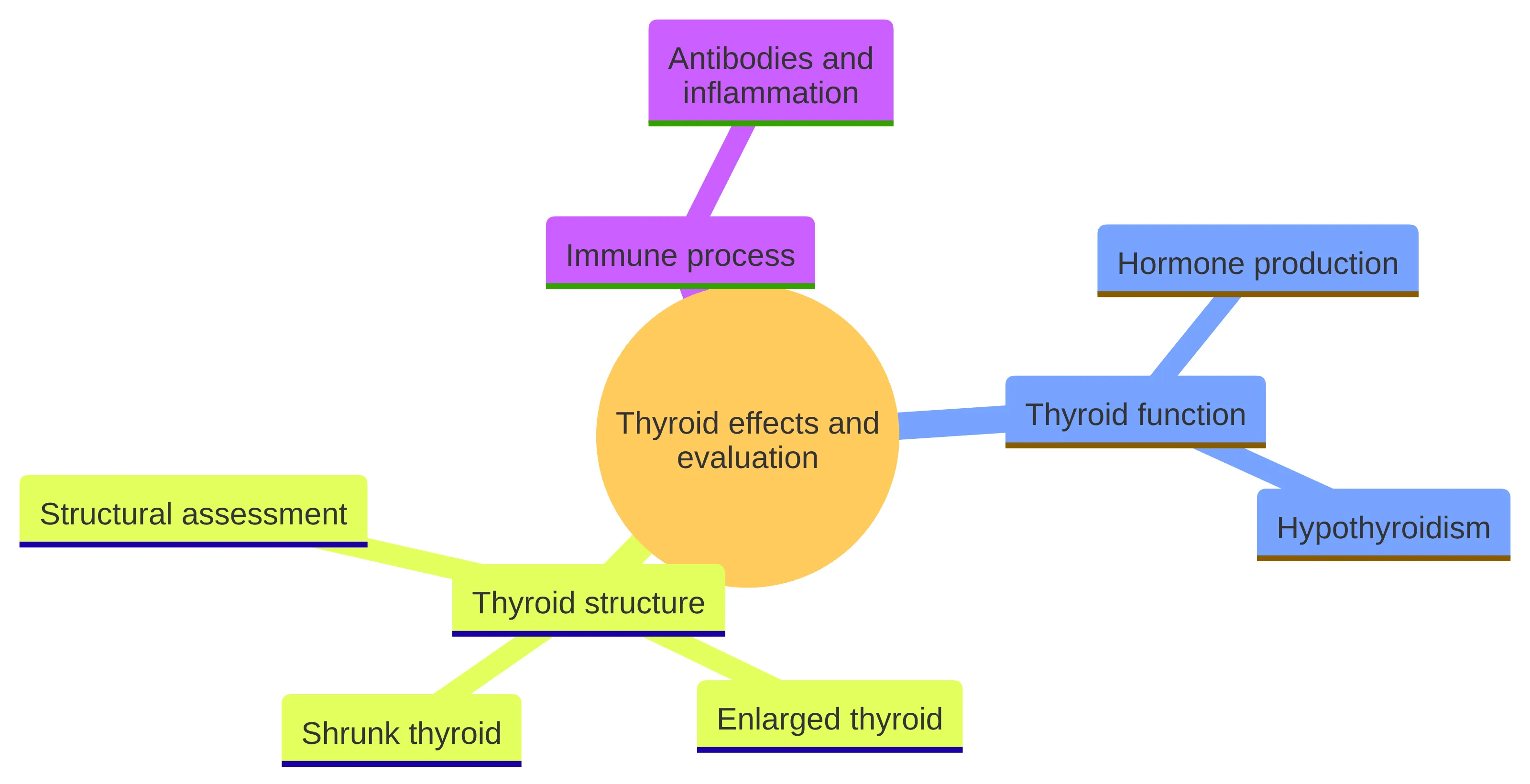
The word “autoimmune” does not tell you the current degree of thyroid dysfunction by itself. Three parts of the conversation need to remain distinct:
- The immune process: whether antibodies and inflammation are affecting the thyroid.
- Thyroid function: whether the gland is producing enough hormone for the body’s needs.
- Thyroid structure: whether the gland has enlarged, shrunk, or otherwise warrants structural assessment.
These questions overlap, but they should not be collapsed into a single conclusion. An antibody result is relevant to the autoimmune question, while thyroid-function evaluation addresses hormone production. Imaging may be considered when the thyroid’s structure or local findings need assessment.
Before accepting a result as a complete explanation, ask what it measures and which of these questions it addresses. That simple distinction can keep a discussion about inflammation from being confused with a conclusion about current thyroid function.
Hashimoto’s can be quiet or clinically significant
The clinical course of Hashimoto’s can range from an asymptomatic or subclinical state to clinically significant hypothyroidism. In practical terms, an autoimmune thyroid process may be present without the same degree of thyroid-hormone disruption that occurs when the gland is no longer making enough hormone.
This range matters because the name Hashimoto’s does not provide an individual prognosis. It does not tell you, without an evaluation, how much inflammation is present, whether thyroid hormone production is currently affected, or how your symptoms should be interpreted. A healthcare professional may need to consider the immune process, thyroid function, and any structural findings together.
Local and systemic effects can also differ. An enlarged thyroid may cause pressure-related symptoms in the neck. Broader symptoms are primarily associated with insufficient thyroid hormones caused by hypothyroidism. The distinction gives you a more useful way to describe your concern: explain whether you have noticed a local change, a broader change in how you feel or function, or both.
The range from quiet or subclinical disease to significant hypothyroidism is also why seriousness cannot be judged from the disease name alone. If you are concerned about a possible thyroid problem, the next useful step is a professional discussion rather than trying to assign a severity level from a symptom or label. The same diagnosis name can describe different clinical situations.
Symptoms may suggest a question, but they cannot establish a diagnosis
Symptoms associated with Hashimoto’s can be vague and nonspecific, and they may overlap with other conditions. A broad change in how you feel or function can raise a thyroid-related question, but it cannot establish that you have Hashimoto’s. This is especially relevant when the concern is based on a single symptom without thyroid-function or autoimmune context.
This distinction is useful during an appointment because it gives you more than a disease name to discuss. You can describe where you notice the problem, when it began, whether it has changed, and how it affects your daily activities. You can also mention symptoms that seem unrelated; the overlap between early Hashimoto’s symptoms and other conditions means that context matters.
A symptom list should support a conversation, not replace an evaluation. Even a symptom that sounds familiar may have more than one possible explanation. The appropriate conclusion is a question for a healthcare professional, not a self-diagnosis.
What a healthcare professional may consider during evaluation
Evaluation for possible Hashimoto’s may consider your symptoms and clinical context, including a review of your history and a clinical examination, alongside antibody testing, imaging, and assessment of thyroid function. These clinical findings help a healthcare professional consider which laboratory or imaging assessments may be relevant. Early symptoms can be vague, and the condition can present in different ways, so the discussion needs to connect your clinical history and findings with what each assessment is intended to clarify.
Before an appointment, write down:
- when you first noticed the concern;
- whether the pattern is steady, changing, or intermittent;
- any local neck changes or broader changes in how you feel or function; and
- questions about what each proposed assessment is intended to clarify.
The laboratory part of the evaluation may include serological markers such as thyroid peroxidase antibodies or thyroglobulin antibodies. These markers relate to the autoimmune question. Thyroid-function evaluation addresses a different question: whether the thyroid is producing enough hormone. Imaging may be considered when the structure of the thyroid or local findings need assessment.
You do not need to turn this information into a personal testing plan. Instead, ask the healthcare professional to explain the purpose of each part of the evaluation and how the pieces fit together. Useful distinctions include:
- Does this assessment address autoimmune activity, thyroid hormone production, or thyroid structure?
- What does each result measure?
- How does the result fit with the symptoms and clinical findings being discussed?
The point of a multi-part evaluation is not to make every result carry the same meaning. It is to keep the autoimmune process, thyroid function, and symptoms from being treated as interchangeable. If a proposed assessment seems unclear, ask which specific question it is meant to answer before drawing a conclusion from it.
History and examination are not merely preliminary steps. They connect the reader’s reported experience with the specific question under review. A timeline can show whether a concern is persistent, changing, or intermittent, while clinical examination can add findings that a symptom description alone does not capture. Together, they may help a healthcare professional decide whether the discussion should focus on thyroid hormone production, possible autoimmune activity, the thyroid’s structure, or another explanation for the concern. Their role is to provide context for deciding what, if any, laboratory or imaging assessment may help clarify the situation; they do not, by themselves, establish Hashimoto’s.
That context also matters when findings do not seem to point in the same direction. A symptom, an antibody result, a thyroid-function result, and an imaging finding can address different parts of the picture. Ask which finding is being used to answer which question and what remains uncertain. Keeping each finding connected to its purpose can make a follow-up discussion easier to understand without turning a single result into a diagnosis. It also gives you a clearer way to ask whether the concern involves the immune process, hormone production, structure, or the meaning of a symptom.
What is known—and uncertain—about how common Hashimoto’s is
The prevalence of Hashimoto’s in the United States is not precisely defined in the available medical guidance. NIDDK reports that the number of people who have Hashimoto’s disease is unknown, while also describing Hashimoto’s as the most common cause of hypothyroidism in the United States. NIDDK reports that hypothyroidism affects about 5 in 100 Americans.
Those statements answer different questions. The figure of about 5 in 100 refers to hypothyroidism, not to the number of people with Hashimoto’s specifically. Calling Hashimoto’s the most common cause of hypothyroidism describes its relationship to that condition; it does not provide a percentage for Hashimoto’s itself.
This distinction is a useful guardrail when you encounter prevalence claims online. A number about hypothyroidism cannot automatically be used as a number about Hashimoto’s. If a statistic matters to your discussion with a healthcare professional, ask what condition the statistic measures, which population it describes, and whether it refers to a cause, a symptom, or a diagnosis.
Questions to bring to a healthcare professional
Questions about Hashimoto’s can help you separate symptoms, autoimmune activity, thyroid function, and thyroid structure during a healthcare conversation. You can bring the following list and choose the questions that match your concern:
- Could my symptoms or clinical findings fit a thyroid-related problem, and what other explanations should we consider?
- What does the thyroid-function evaluation measure?
- Would antibody testing be relevant to the autoimmune question in my situation?
- If antibody testing is discussed, what do thyroid peroxidase antibodies or thyroglobulin antibodies measure?
- Is there a reason to consider imaging based on the thyroid’s structure or local symptoms?
- Does the overall picture suggest an asymptomatic, subclinical, or clinically significant thyroid problem?
- How should the symptoms be interpreted if they overlap with other conditions?
- Which finding in the evaluation would answer the question about thyroid hormone production?
- What remains uncertain after this discussion, and what follow-up conversation would address that uncertainty?
These questions are designed to clarify the evaluation, not to tell you which tests you personally need. Ask the healthcare professional to connect each answer to the specific question it addresses. For example, an antibody result and a thyroid-function result should not be treated as though they measure the same thing.
You can also ask for plain-language explanations of unfamiliar terms. If “subclinical” or “hypothyroidism” appears in a discussion, ask how the term applies to the thyroid-function question being considered. Clear definitions can prevent a broad disease label from being mistaken for an individual conclusion.
Bring your timeline, relevant symptoms, and the questions that matter most to you. A focused conversation is easier to follow when you know whether you are asking about the immune process, hormone production, the thyroid’s structure, or the meaning of a symptom.
One way to organize the conversation is to group questions by purpose. Start with the concern itself: which symptoms or clinical findings need explanation? Then ask about function: what does the thyroid-function evaluation show? Next ask about autoimmunity and structure: would antibody testing or imaging add relevant information in this situation? End by asking what is known, what remains uncertain, and what follow-up discussion would address that uncertainty. This sequence does not tell you which assessments to request. It helps keep the conversation from treating Hashimoto’s as a single, undifferentiated finding.
The same structure can help when a healthcare professional uses a term that is unfamiliar. Ask whether the term describes the immune process, thyroid function, thyroid structure, or a symptom pattern. Then ask how that term relates to the specific concern being discussed. Clear category labels can make the discussion easier to follow while preserving the distinction between general information and an individual conclusion.
Use the information to plan an informed follow-up conversation
The practical meaning of Hashimoto’s is easier to understand when you keep four questions separate: Is an autoimmune process affecting the thyroid? Is thyroid hormone production currently affected? Are symptoms local, systemic, or overlapping with another condition? What does the evaluation actually measure?
Hashimoto’s can be quiet or clinically significant, and symptoms alone cannot establish the diagnosis. A qualified healthcare professional must determine what the findings mean for your individual situation.
Common questions about Hashimoto’s disease and evaluation
What is Hashimoto disease and how does it affect thyroid function?
Hashimoto disease, also known as Hashimoto’s thyroiditis, is an autoimmune disorder where antibodies attack the thyroid gland, causing inflammation. This can impair the thyroid’s ability to produce hormones, potentially leading to hypothyroidism.
What questions should I ask my healthcare professional about Hashimoto disease?
You may ask about the relevance of your symptoms to thyroid issues, what specific tests will measure, and how the results relate to your overall health. It’s also helpful to inquire about the implications of any findings.
How common is Hashimoto disease in the United States?
The exact prevalence of Hashimoto disease is not well defined, but it is recognized as the most common cause of hypothyroidism, which affects about 5 in 100 Americans.
What distinguishes Hashimoto disease from other thyroid conditions?
Hashimoto disease is characterized by an autoimmune attack on the thyroid, which can lead to inflammation and varying degrees of thyroid dysfunction.
Hormone therapy
Wondering if your hormones are behind how you feel?
Dr. Brian Hoff sees patients at our boutique, cash-based practice in downtown Fredericksburg, VA — with time to listen and a plan built around you.
More on Hormone Therapy & BHRT
See hormone therapy Hormone Therapy & BHRT
Hashimoto Disease: What It Means, How It Is Evaluated, and When to Seek Care
Learn what Hashimoto disease means, how thyroid function is evaluated, and which questions to bring to a healthcare professional.
Read article Hormone Therapy & BHRT
Hashimoto Disease: How Autoimmunity, Symptoms, and Thyroid Tests Fit Together
Understand Hashimoto disease, its symptoms, thyroid tests, and what to ask a healthcare professional about evaluation and monitoring.
Read article Hormone Therapy & BHRT
10 Benefits of Hormone Replacement Therapy Near You
Discover the transformative benefits of hormone replacement therapy near me for enhanced well-being.
Read article